This post is also available in:
For the fifth entry in my “clear indie games and write about them” series, IndieGame100, I’m diving into Dungeon Destroyer!!
Dungeon Destroyer Review
This one’s for you—yeah, you—who’s thinking:
“I just want to play something fun!!”
I hope this reaches you. Seriously. Please reach. Will it reach??
Anyway—this series is all about one thing:
putting “fun” into words.
Not just for players, but hopefully also useful for developers who are struggling with how to communicate what makes their own game special.
…Oh, and by the way, this is actually a bit of a nostalgic title for me.
I got to try it at a booth during Tokyo Game Dungeon 10, and it stuck with me ever since.
If you’re curious, you can check out my impressions from back then in the event report too.
Alright then—let’s get into it!!
Time to DESTROY.
- Build walls, break walls. Simple system, insanely dense thinking
- Puzzle + resource management + upgrades + randomness = strong roguelike feel
- UI around leveling, shop, and saving is a bit confusing
Overview
- Genre: Puzzle? RPG?
- Developer: TUKUCHAU-OJISAN
- Publisher: TUKUCHAU-OJISAN
- Country: Japan
- Time to clear: ~9 hours
- Store Page (Steam)
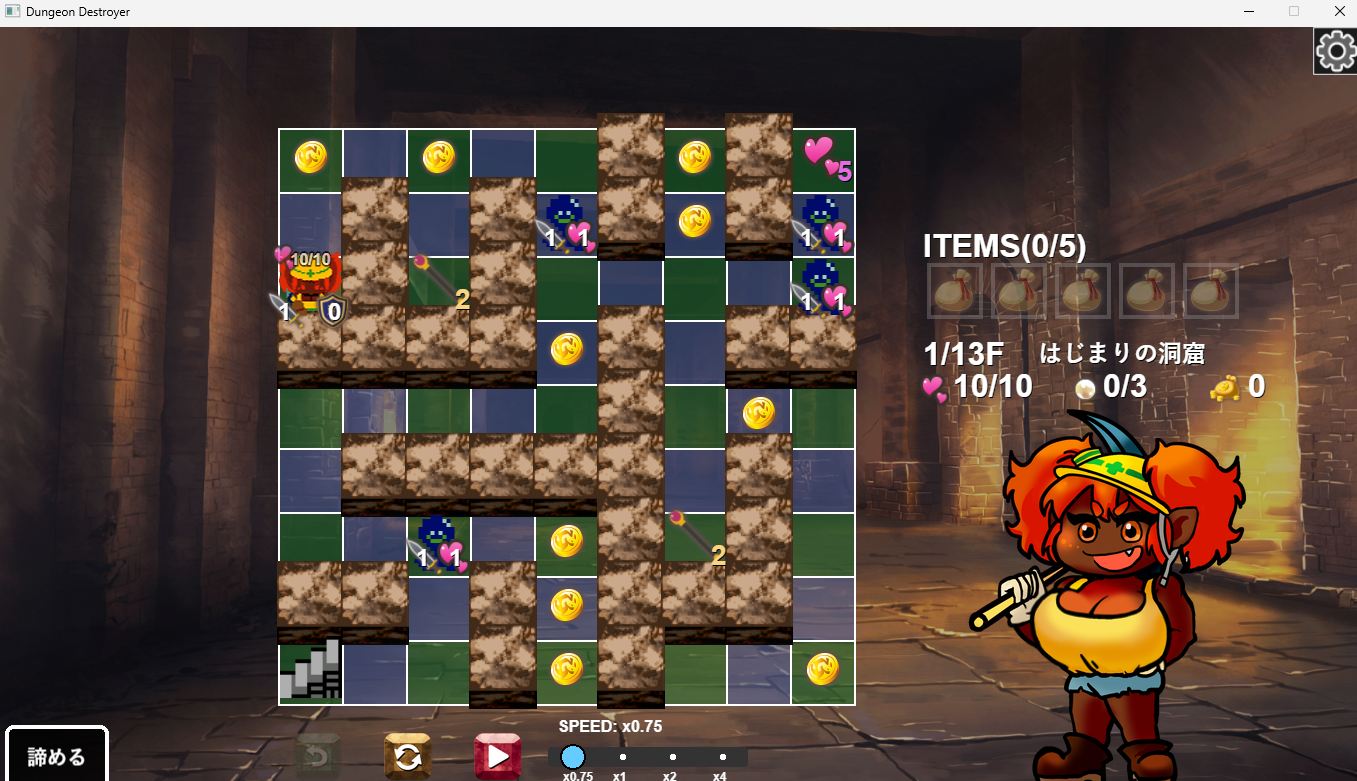
At its core, this is a stage-based puzzle game.
You place walls in a dungeon, break them, and create a path for a little dwarf girl to reach the goal. Do that across a set number of floors, and you clear the difficulty.
Defeat enemies to gain EXP, level up, and assign stats.
You’ll also be managing items and money you pick up along the way, so despite how it looks, there’s a surprising amount of depth here.
I barely play puzzle games—and I still managed to clear it—so difficulty-wise, it feels fair. Not too easy, not too brutal.
(Though honestly, I’m probably the worst possible benchmark. Forgive me.)
Simple System, Deep Gameplay
What you do in each stage is really simple:
- Place walls
- Break walls
- Destroy traps
- Use items
That’s it.
The dwarf girl automatically follows the route you created, picking up items, collecting money, and fighting enemies along the way.
After clearing a stage, you:
- Allocate stats
- Spend money on upgrades
- Recover HP
That’s basically the whole game loop.
It’s so simple you could explain almost everything in a few lines.
And yet—that simplicity is exactly why the game goes all-in on making you think.
The Core Dilemma: HP Is Everything
Here’s the catch:
Creating and destroying walls costs HP.
Which leads to situations like:
- “If I grab everything, I end up at 1 HP and die to a trash mob.”
- “If I conserve HP, I miss items and fall behind in power.”
So you’re constantly asking yourself:
- “Is this item worth spending HP to get?”
- “Is it worth avoiding this fight, even if it means losing EXP?”
You’re trapped in this dilemma the entire time—and that’s where the game really shines.
Why It Feels Like a Roguelike
Yes, it’s a puzzle game—but your brain doesn’t feel like you’re playing one.
You’re constantly thinking things like:
- “My damage is kinda low right now…”
- “What if I don’t get a shield next floor?”
You’re not just solving the current stage—you’re planning for what comes next.
On top of that, stages are randomly selected.
Which means:
- Maps change
- Item drops change
- Coin availability changes
And suddenly, your “optimal solution” isn’t fixed anymore.
- “This stage is brutal… but I happened to have a wand, so it was easy.”
- “I could clear this if I use a buff… but what if I don’t get one later?”
The result?
A constantly shifting decision space shaped by your playstyle and RNG.
At that point, it doesn’t feel like a puzzle game anymore.
It feels like a roguelike.
Now I totally get why the dev at Tokyo Game Dungeon said:
“I’d love to hear what genre you think this is.”
Because honestly—it doesn’t fit neatly into any box.
The UI That Makes It Addictive
What really pushes this game over the edge is how easy it is to retry.
During play, you can:
- Undo your last move
- Reset to the initial state
All in one click.
Even if the dwarf girl dies, it’s not game over—you just go back one step.
On top of that, you can control movement speed:
- Slow (0.75x)
- Fast-forward (2x / 4x)
So you can:
- Test a strategy quickly
- Carefully review what went wrong
Dense thinking + instant retry =
you will lose hours to this.
The “Romance” Setting (Yes, Really)
There’s… an option.
A “romance” setting.
You can adjust… bounce.
I won’t say what. You know.
And not just a little—
you get seven different parameters:
- X-axis movement
- Y-axis movement
- Angle differences
- Duration
- …and more
For context, the normal settings are just:
- BGM volume
- SE volume
- Screen size
So yeah.
This one setting alone has more options than everything else combined.
…Did you maybe put a bit too much effort into this?
Downsides: UI Clarity
A couple of things bothered me:
- During leveling and in the shop, HP and inventory are hard to see
- It’s unclear how saving works
Because this is a game about planning based on your current state, not being able to clearly see that state is a bit frustrating.
As for saving—there’s a “Give Up” button during stages, which makes you think:
“Wait, I can quit… but I can’t save?”
That part could definitely be clearer.
Final Thoughts
This is a game that blends puzzle mechanics with:
- Resource management
- Progression systems
- Randomness
…to create something that doesn’t really fit into a traditional genre.
Its simplicity, depth of thought, and ease of retry combine into something dangerously addictive.
The UI has a few rough edges, but from start to finish, you’re constantly wrestling with meaningful, satisfying dilemmas.
And that’s what makes it great.
That’s it for Dungeon Destroyer!
For IndieGame100 #6, I’ll be covering Crimson Dusk’s “Homura Hime” (炎姫).
I’ll be posting progress updates over on X with the hashtag #IndieGame100, so feel free to follow along!
In the strategy guide, I also dug into the game’s unique resource management system, so if that sounds interesting, definitely give it a read too!
So, enjoy your gaming life!!
And thanks for reading all the way to the end!
You can also check out the previous IndieGame100 entry here:
Over on X, I post article updates and yell about whatever game I’m currently playing.
It’s about 1.3 times louder than the blog.
(According to our highly scientific internal estimates.)
For Game Developers
On this site, I take commissions for review articles and interview articles, mainly focused on indie games.
What I especially care about is:
- putting the player experience into words
- breaking down system and combat design
- making a game’s concept and appeal clearly visible
If you’ve ever felt like:
- “My game is interesting, but its appeal isn’t fully coming across in words”
- “I want the design intent and core identity of my game to be properly communicated”
…then I’d be genuinely happy if I could help with that.
If you’re interested, feel free to check the links below and reach out anytime.
Game Review & Interview Writing Services – Kaburanai Games
Contact us – Kaburanai Games