This post is also available in:
So yeah—this time on IndieGame100, I’m diving into The Use of Life, and man, I went ALL in on this one.

Whether you’re a full-on game junkie or just someone curious about weird, standout titles—this one’s for you.
I spent about four months clearing every ending, trying every base class and advanced class, and really digging into what makes this game tick. So here, I’m gonna break down what actually makes it fun—both from a player experience perspective and from a design standpoint.
I’m also super serious about putting “fun” into words, so if you’re a developer struggling with how to communicate what makes your game special, I hope this gives you something useful too.
Don’t worry—I’ll avoid spoilers as much as possible.
Alright, let’s get into it!!
- A “modern classic” JRPG that refines and evolves old-school elements
- Battles that fully deliver on “trial and error,” “learning through death,” and pure tension
- A heavy story centered on how you use your “life,” with occasional humor and cuteness
- It’s dense—like, REALLY dense—so be ready, this game will drain your energy
- Game Overview
- What It Takes from Gamebooks—and What It Leaves Behind
- Reading the Fight: How Enemy Forecasts and QTEs Create Real Tension
- Character Customization That Completely Changes How the Game Feels
- A Heavy Story… and Yes, a Cute Beastgirl Heroine Is Here Too
- The One Downside: This Game Takes a Ton of Mental Energy
- Final Thoughts
- For Game Developers
Game Overview
Genre: RPG
Developer: だらねこげーむず/Daraneko Games
Publisher: PLAYISM
Country of Origin: Japan
Playtime: It took me just under 20 hours to finish my first playthrough, and around 55 hours to clear every ending.
This is a “modern classic” JRPG built around the theme of how you use your life, featuring a gamebook-style story progression and battles that combine QTEs with deep strategic gameplay.
Just to be clear, the phrase “modern classic JRPG” isn’t something I came up with myself—it’s actually taken from the game’s official store page.
But honestly, it describes the game so perfectly that I had to borrow it.
That phrase really captures this game’s core attitude:
it doesn’t stop at the foundation built by the classics—it tries to go beyond it.
This is not just a “good old nostalgic” kind of game.
Instead, it feels like a game that carefully picks out the parts of classic game design that still hold up today, while confidently throwing away the parts that would feel frustrating or outdated to modern players.
In that sense, this game feels less like a throwback and more like a reconstruction of the classics.
What It Takes from Gamebooks—and What It Leaves Behind
What makes this game interesting isn’t just that it feels like a gamebook.
If you dig a little deeper, what it really does is take that core idea—being responsible for your own choices—and elevate it into the heart of the entire gameplay experience.
So… what even is a gamebook?
Some of you might not be familiar with them, so here’s a quick explanation.
Basically, it’s like a choose-your-own-adventure book, but with dice rolls added in to determine battle outcomes and exploration results.
You decide what to do—fight head-on, sneak past, whatever—and then roll the dice to see how it goes. Based on the result, you’re told which section to read next, and from there you make your next decision.
Rinse and repeat—that’s the flow.
Famous examples would be Sorcery! or Arena of Khazan.
And yeah, The Use of Life follows that kind of structure.
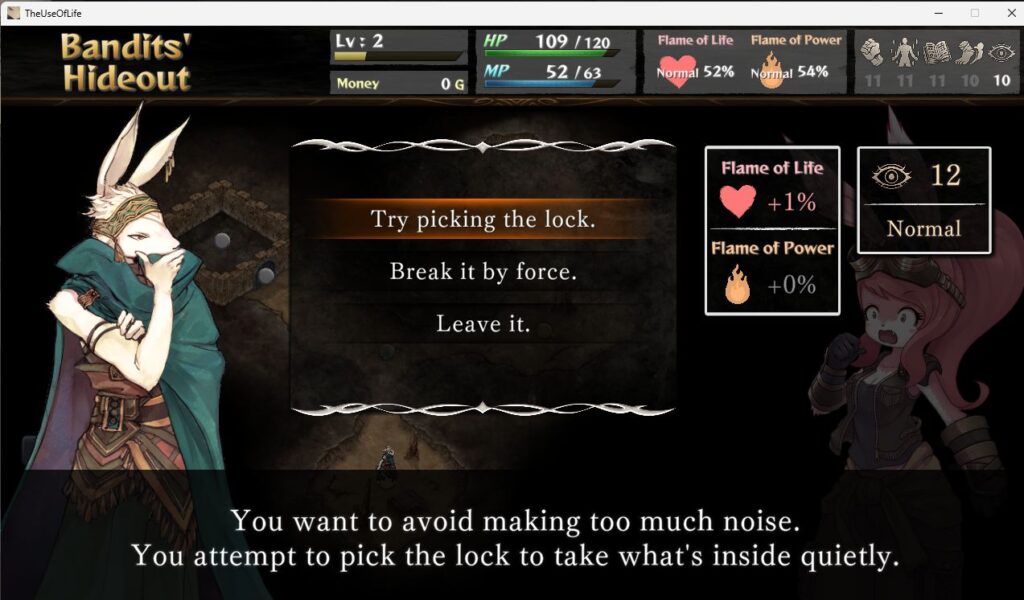
If you’re into analog games, it’s probably easiest to think of it as a solo-playable TTRPG.
In fact, a lot of TTRPG systems out there literally market their solo scenarios as “playable like a gamebook.”
Respect for Gamebooks
Where this game clearly inherits from gamebooks is in how it puts you in the protagonist’s shoes, and lets your choices directly shape what happens.
Two things really stand out:
- No fake choices
- The narration consistently addresses you as “you”
No fake choices
This is a big one—and it’s a design-level decision.
Imagine a scene like this:
“You have to decide whether to betray your ally.”
▶ Betray them
▷ Don’t betray them(You pick “Betray them”)
“You can’t betray your ally! Let’s rethink your bond!!”
“You have to decide whether to betray your ally.”
…yeah, infinite loop.
A bit exaggerated, sure—but you’ve definitely seen stuff like this in JRPGs before, right? (And no, I’m not saying those games are bad—just to be clear.)
But in The Use of Life, that kind of thing doesn’t exist.
If you choose something, your character actually does it. No loops, no take-backs.
And sometimes, those choices lead to brutal, painful endings.
The narration always calls you “you”
This is more of a presentation thing, but it’s still important.
Gamebooks originally came from English-speaking regions, where the narration directly addresses the reader as “you.”
That’s why, even in Japanese translations, the protagonist is often referred to as “you” (君).
And The Use of Life sticks to that style throughout, clearly following that classic gamebook tradition.
What It Changes for Modern Playability
Now, while the game clearly respects gamebooks, it also intentionally removes a lot of their traditional elements.
And almost all of those removals are about making the experience smoother and easier to engage with for modern players.
Let’s go through them one by one.
No instant-death choices
Instant-death choices are basically a gamebook trademark.
Like this:
You’re a powerful warrior with unmatched strength.
During your journey, you find a shabby hut where an old woman lives.
She kindly offers you food and a place to stay.
Wanting to conserve your strength, you accept.
After finishing the soup she gave you, something feels off.
Your hands start shaking. Your heart races. Your vision blurs. Your skin turns purple.
You’ve been poisoned.
As your consciousness fades, the last thing you see is the old woman approaching you with a knife.
Your adventure ends here.
~End~
Yeah… not even that extreme. Stuff like this is pretty common in gamebooks.
Even a character built entirely for combat can get wiped out without ever fighting.
And sure, that kind of randomness can feel like a “real adventure”—but in a modern RPG focused on combat, it can just feel unfair.
The Use of Life doesn’t do that.
Even if you fall into a trap, you’ll just lose some HP or MP—you won’t get instantly game over.
And as I’ll mention later, this game puts a heavy emphasis on combat, so there’s a consistent rule:
If you lose, it’s because you lost a battle.
Because of that, the overall flow feels really clean:
You explore a dangerous world → and then you settle things in combat.
You get to enjoy your own unique journey, and still get a solid sense of progression through builds and battles.
It never betrays your expectation that “this is a game where combat matters”—which feels very modern.
No looping maps, no need for manual mapping
Another classic gamebook “curse.”
You think you’re making progress, but actually you’re stuck in a loop unless you pick the exact right path.
To deal with that, players often had to draw their own maps—literally charting out the structure to find an escape route.
That kind of old-school “suffering” (let’s be honest) doesn’t exist here.
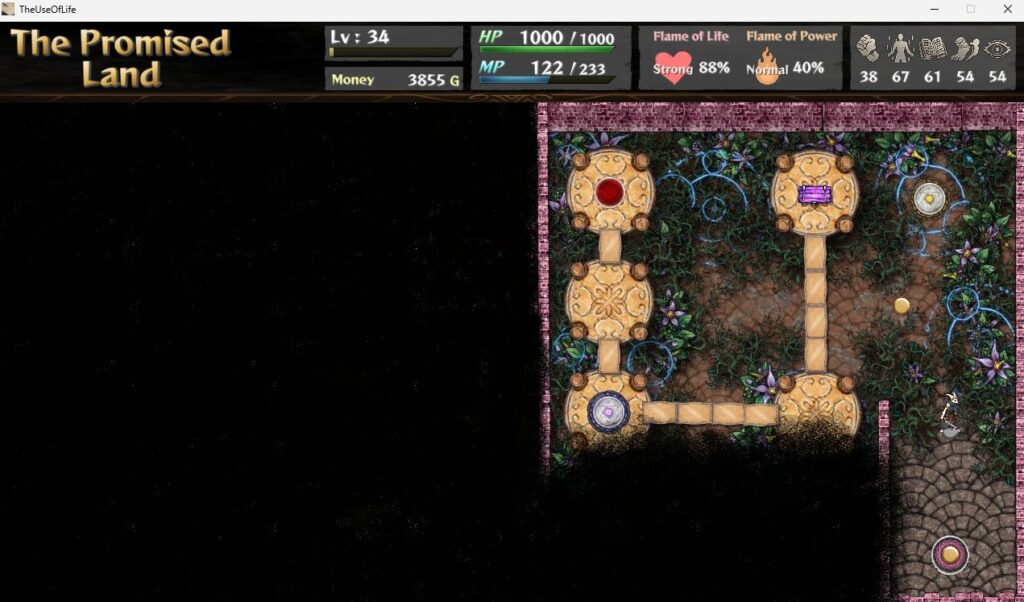
Your current location and available paths are clearly shown, and the map structure doesn’t loop infinitely.
The “roll-under” option feels aimed at TTRPG play journal fans
In Japan, a lot of people got into TTRPGs through play journal videos on platforms like Nico Nico or YouTube.
And in Japan, the most famous system in that space is probably Call of Cthulhu.
That system uses a “roll under your stat” mechanic—if your dice result is lower than your stat, you succeed.
Interestingly, The Use of Life lets you switch to a roll-under system in the options.
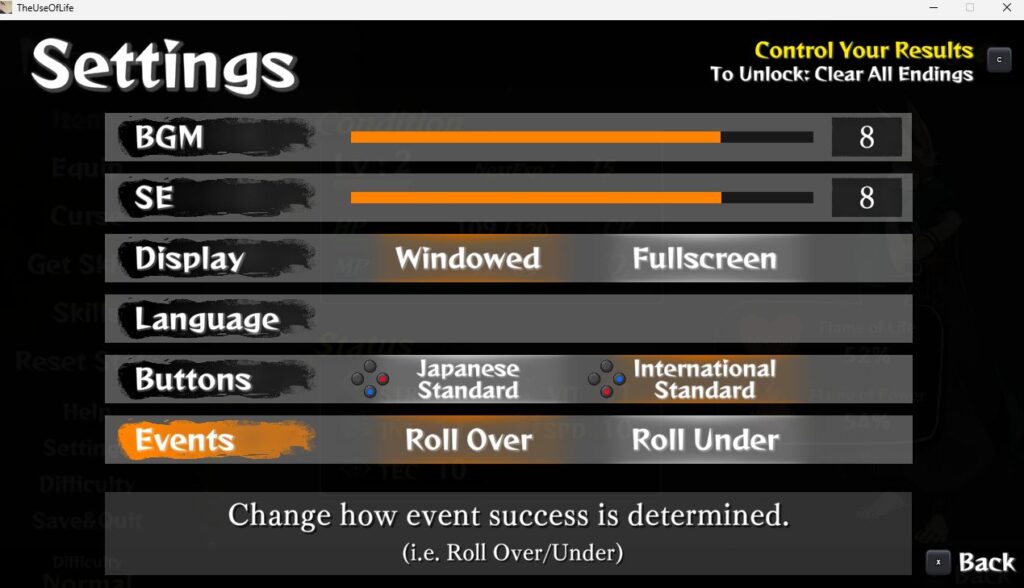
It’s not something the game calls attention to, but it feels like a deliberate nod toward modern Japanese TTRPG culture.
Reading the Fight: How Enemy Forecasts and QTEs Create Real Tension
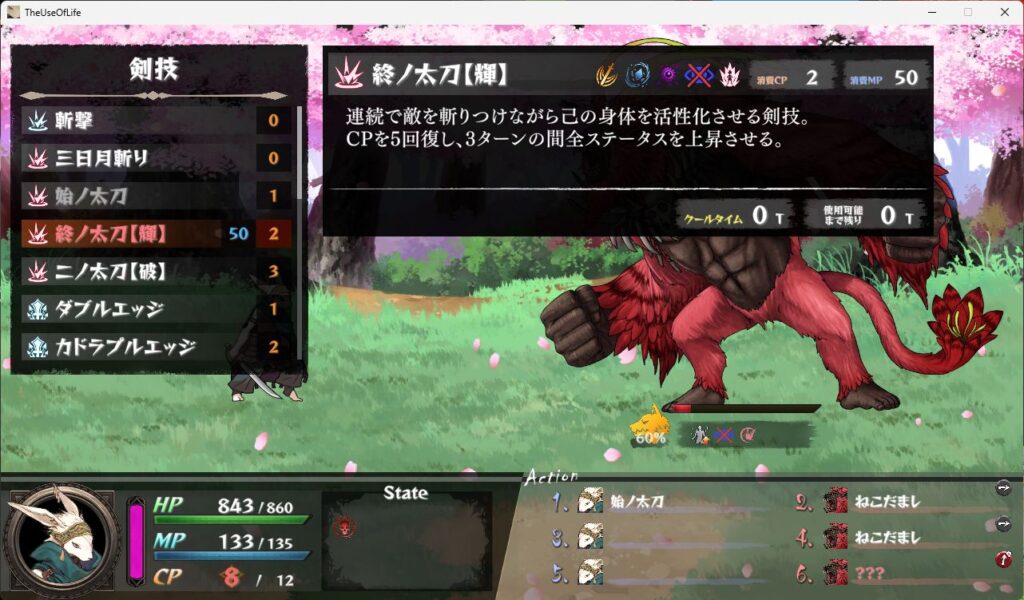
The battle system in The Use of Life feels like something that should have existed already, and yet somehow didn’t.
At the start of each turn, the game shows you the enemy’s predicted actions in the bottom-right corner of the screen.
Based on that information, you choose three actions in advance. Then, when the enemy attacks, you guard or dodge through QTEs.
That’s the basic flow.
As you build up damage on an enemy, they enter an enraged state. Their attacks get nastier—but at the same time, the damage you deal also goes up.
On top of that, after an enemy uses a big move, the next action becomes a window where you can hit them for extra damage.
You can also build up a Boost gauge, which lets you increase your damage output or reduce incoming damage.
Boss fights lean heavily into that classic “learn by dying” style of design, where the key is reading the boss’s patterns and optimizing both your strategy and your build.
A command battle system built for planning
What makes this work so well is how naturally all of these systems fit together:
- enemy action forecasts
- the rage mechanic
- bonus damage after big attacks
- the Boost system
They all mesh beautifully with command-based combat.
Say you know the enemy is about to use a powerful attack while sitting right on the edge of rage mode.
Now you’ve got real decisions to make:
- Do you focus entirely on defense and survive the big hit?
- Do you start stacking attack buffs now so you can unload huge damage right after the big move?
- Or do you play it safe, heal up, and chip away carefully while preparing for the transition into rage?
And it goes even deeper than that.
You can deliberately push the enemy into rage, bait out their big move, and plan your buff order two turns in advance so you’re ready to dump your highest burst damage at exactly the right moment.
That kind of control over the flow of battle feels fantastic.
And the wild part is, the rules themselves are incredibly simple.
But those simple rules create a huge amount of strategic depth.
Especially once you add enemy action prediction into a familiar command battle format—the level of tactical planning jumps way up.
Honestly, I’d love to see more games use this style of combat.
QTEs that make the fight feel real
Guarding and dodging are handled through QTEs—timed button presses where better timing means less damage taken.
And this isn’t just a flat reflex check, either.
The timing window gets wider if your equipment is lighter and your SPD stat is higher.
Debuffing the enemy’s speed or inflicting Blind can help too.
What that means is that your build directly affects how easy it is to handle the timing.
So in a command-based RPG, you end up getting something that feels a little like an action RPG:
your build shapes the rhythm of the fight itself.
Now, what happens when that kind of timing-based tension gets layered on top of all the strategic depth I talked about earlier?
A lot, actually.
You might get so locked in on your damage plan that you neglect your dodge timing.
Or you might get so obsessed with nailing your defense that your offensive plan completely falls out of your head.
And if you’ve got the boss right on the ropes, only to mistime a dodge for a split second and eat a counterattack…
Yeah. That panic is real.
Calm down. Think. How do I kill this thing right now?
That feeling—thinking through the fight while still being forced to engage with it in the moment—is what gives this combat its bite.
And to be clear, “feeling like you’re really fighting” doesn’t just mean “the game demands fast reflexes.”
But it also doesn’t mean “you can lazily think things over while snacking on potato chips,” either.
It’s that brief flash of tension that comes after all your planning—the moment where thought turns into execution—that really sells the feeling of I’m in a fight right now.
Character Customization That Completely Changes How the Game Feels
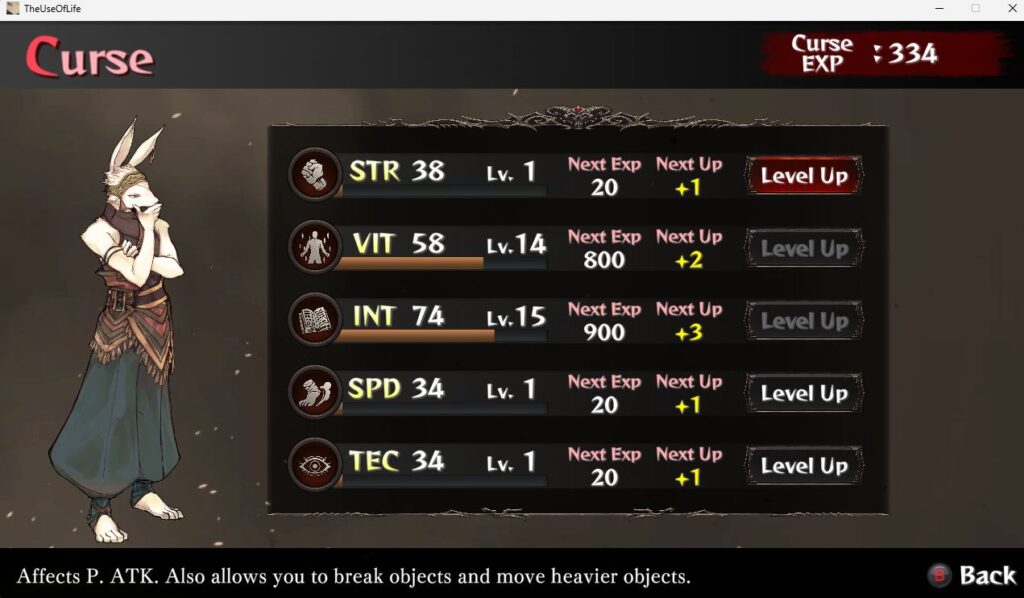
Another major part of combat in The Use of Life is character customization.
There are two main parts to it:
- freely allocating your stat points
- learning skills by choosing classes
And the nice thing here is that each individual point actually matters a lot.
Just putting a few points into a stat can noticeably boost your damage output or make enemy attacks much easier to dodge.
The class system is also nicely varied, with options ranging from pure damage dealers to status-effect specialists to crit-focused builds and more.
And those customization choices don’t just affect your numbers—they directly change how the game feels to play.
Let me give you an example.
One of the advanced classes is Sage, which specializes in magic.
Like I mentioned in my separate class breakdown, Sage can unleash huge burst damage by using a charge action called Chanting first.
And this works beautifully with the systems I talked about earlier—enemy rage, bonus damage windows after big attacks, and the Boost system.
Basically, Sage is all about setting up the perfect “NOW!!” moment and dropping a giant spell right on cue.
On the other hand, Swordmaster plays very differently.
Swordmaster is great at recovering resources, which means it’s built for just constantly dumping those resources back into mid-power skills over and over again and going toe-to-toe in a straight-up slugfest.
Same battle system, completely different feel.
And that’s what makes the customization so satisfying.
When you combine this kind of build variety with the game’s strategic depth and its QTE-based combat, you get something really fun:
the thrill of beating a powerful enemy through trial and error, using a playstyle you chose for yourself.
That feeling lands hard.
A Heavy Story… and Yes, a Cute Beastgirl Heroine Is Here Too
A brutally serious story about “life”
As the title suggests, this game is deeply focused on how life is used, and because of that, the story goes to some very heavy places.
It’s not just the protagonist who has to confront that theme—many of the NPCs are wrestling with it too, in one form or another.
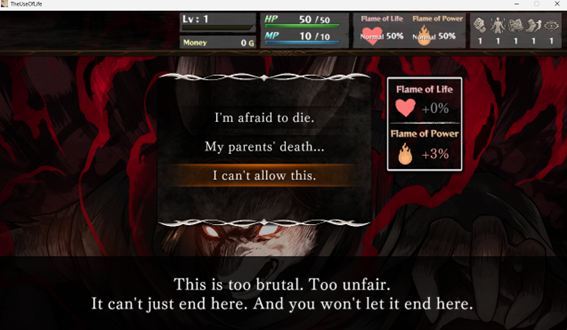
The game uses a multi-ending structure, where the protagonist Gauche’s obsessions and attachments shift depending on the player’s choices surrounding “life,” and those choices lead to different endings.
And what I really liked is that every ending, in its own way, carries pain—but also some kind of hope.
They leave you with a surprisingly good aftertaste.
At the same time, the game never tries to dodge the consequences of the choices Gauche has made.
So even when there’s a sense of emotional payoff, it never feels cheap or overly convenient.
Trying to avoid spoilers here, but personally, my favorite ending route was the one where Gauche starts out clinging desperately to life and battle, but gradually begins opening up emotionally to other people.
Damn it, I wanna talk about this with full spoilers so bad!!
The gap between the heavy and the cute
That said, the game isn’t relentlessly grim from start to finish.
There are actually a fair number of funny moments and genuinely cute scenes sprinkled throughout.
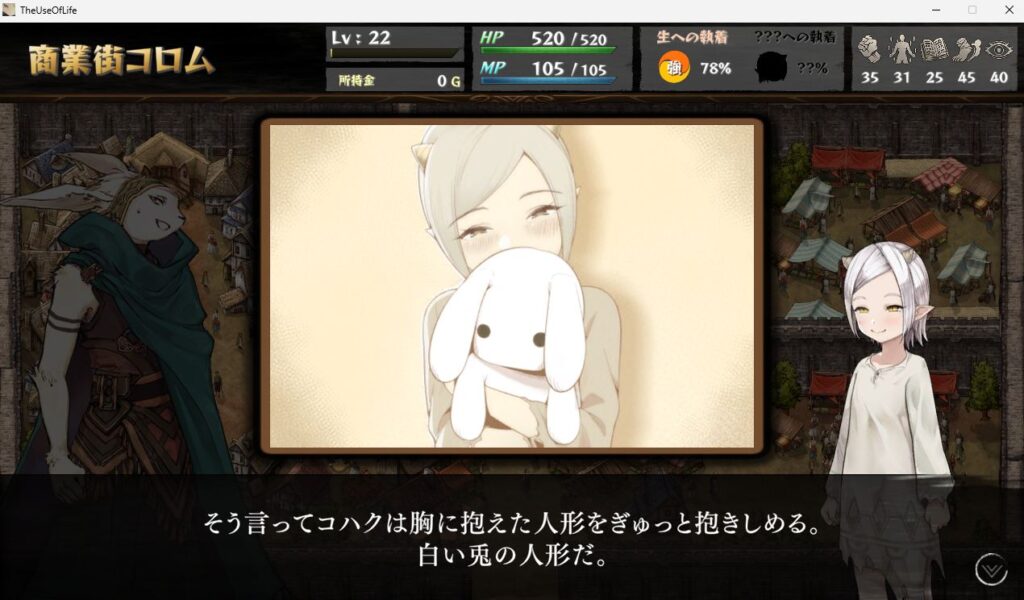
Cute.
And honestly, Gauche himself pulls this off surprisingly well.
He makes this sort of awkward, troubled expression a lot, and after clearing every ending, my impression of him is basically:
not quite a full-on cool guy—more like a “a slightly awkward, almost-there hero.”
And those lighter moments do more than just give you a breather.
They also make you stop and ask yourself things like:
- “Is it really okay to just keep fighting like this?”
- “Are there other ways to use a life besides throwing it into battle?”
That emotional contrast gives the story a lot of weight.
Personally, I suspect that a big part of this game’s unusually strong sense of immersion comes from that contrast between the serious and the silly.
But hey… maybe that’s just me.
The One Downside: This Game Takes a Ton of Mental Energy
I’ve been praising this game pretty relentlessly up to this point, but yeah—it’s time to bring up the downside.
And it’s a simple one:
this game takes a ridiculous amount of energy to play.
You’re constantly:
- thinking hard about strategy and builds
- burning serious focus on QTE timing
- getting emotionally hit by the heavy story
- getting unexpectedly delighted by the funny or cute scenes
- and then catching emotional whiplash from the tonal shifts
In short, this game absolutely chews through your own MP as the player.
I happened to be playing this during a time when life was already kind of hectic and draining, so it actually took me four full months to clear every ending.
And honestly, that makes sense.
The flip side of this game’s high level of quality—across its systems, combat, and story—is that the whole experience is just extremely dense.
So while I absolutely think it’s great, it’s not really the kind of game I’d call “easy to pick up casually.”
No matter how amazing a full-course meal is, it’s still too heavy if all you wanted was a light snack.
This is a game I’d especially recommend to people who are in the mood to sit down and really sink their teeth into something rich.
Final Thoughts
The Use of Life is a game that takes classic elements like gamebooks and command-based battles, then pushes past them into something that genuinely feels like the next step beyond the classics.
Its combat combines deep strategy with high-tension QTEs, and especially in boss fights, the sense of victory can feel almost Soulslike in how satisfying it is.
The story tackles life and the cost of your choices head-on without flinching, while the naturally woven-in comedic moments create a surprisingly powerful sense of immersion.
It’s definitely a bit too dense to recommend as a casual “pick-up-and-play” kind of game—but it absolutely has the level of quality to justify that weight.
So yeah, that’s my write-up on The Use of Life!
For the fifth entry in IndieGame100, I’m planning to cover Dungeon Destroyer by T
TUKUCHAU-OJISAN
I’ll also be posting my play progress over on X with the hashtag #IndieGame100, so feel free to follow along there too!
Enjoy your gaming life!!
Thanks so much for reading all the way to the end!!!
You can also check out the previous IndieGame100 entry here:
Dungeon Antiqua – My Thoughts After Beating the Secret HARD Boss | IndieGame100 #3 – Kaburanai Games
If you enjoyed this article, buy me a healing potion! 👇
Optional support to help keep this adventure going.

For Game Developers
On this site, I take commissions for review articles and interview articles, mainly focused on indie games.
What I especially care about is:
- putting the player experience into words
- breaking down system and combat design
- making a game’s concept and appeal clearly visible
If you’ve ever felt like:
- “My game is interesting, but its appeal isn’t fully coming across in words”
- “I want the design intent and core identity of my game to be properly communicated”
…then I’d be genuinely happy if I could help with that.
If you’re interested, feel free to check the links below and reach out anytime.
Game Review & Interview Writing Services – Kaburanai Games
Contact us – Kaburanai Games