This post is also available in:
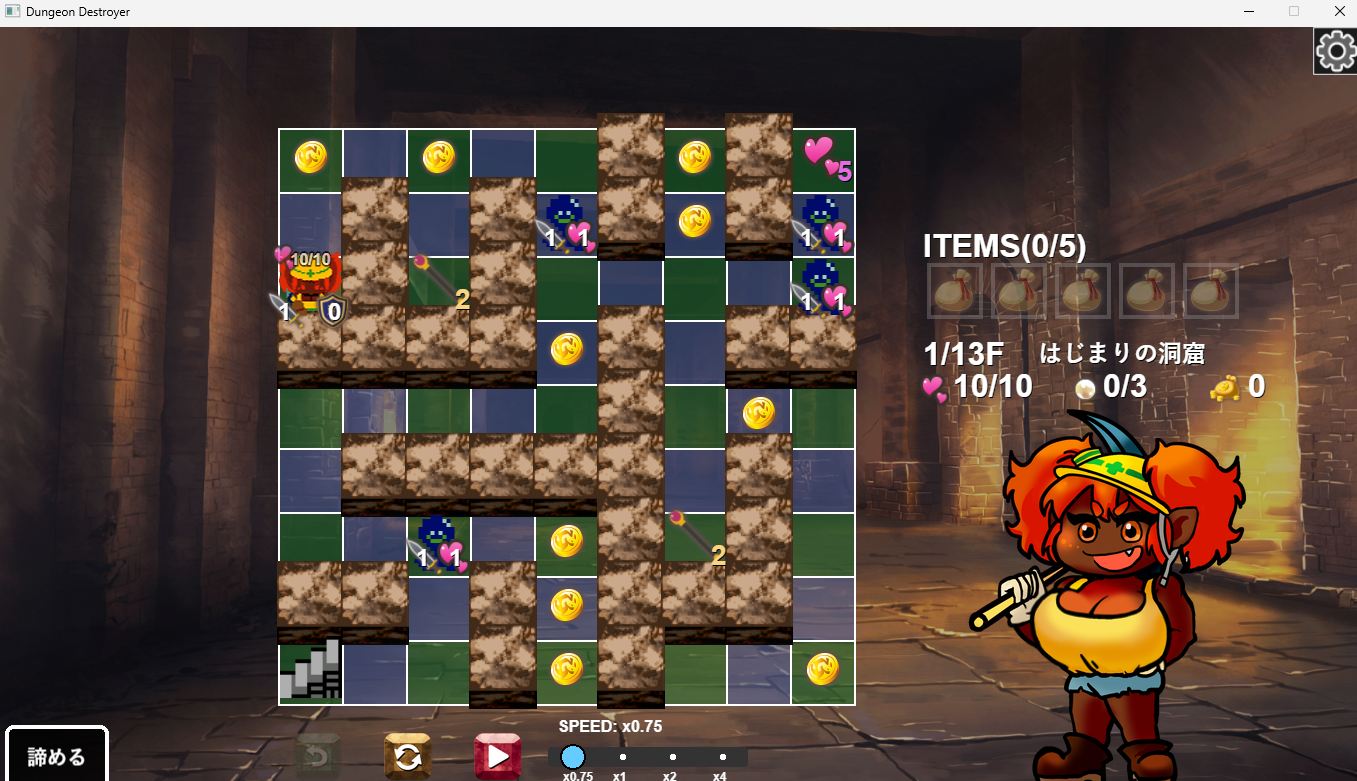
So, I finally cleared Dungeon Destroyer, and I figured I’d put together some tips.
Hopefully this helps if you’re stuck somewhere.
Alright, let’s get into it.
- Prioritize collecting items and coins above everything else
- For stats, focus on Defense. For items, wands are insanely important
- Always ask yourself: “How many hearts do I gain by breaking this wall?”
Core Strategy
First things first: prioritize items and coins. Always.
If you build your routes around that idea, you’ll end up fighting almost every enemy anyway—unless you’re intentionally isolating something dangerous.
The nice part?
You don’t have to think about “should I fight this for EXP?” anymore.
That alone makes decision-making way easier.
How Saving Works (Yeah, It’s Weird)
There’s no obvious “save” button—only a “give up” option, which is confusing.
But don’t worry, you can save mid-run.
Click the gear icon in the top-right corner,
then choose “Exit Game” from the settings menu.
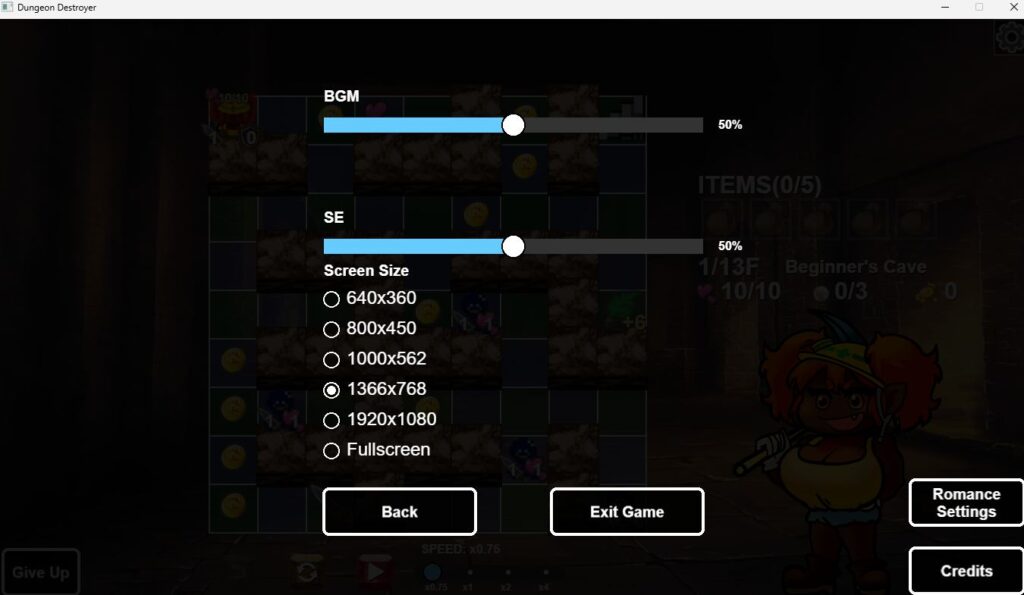
That’ll save your progress and exit properly.
Stat Priority on Level Up
Think of it roughly like this:
Defense >> HP > Attack
Here’s why:
- Defense scales extremely well the more you stack it
- High HP alone isn’t enough if your Defense is low—you’ll just bleed coins on healing
- You’ve got swords (attack boosts) and wands (direct damage), so base attack isn’t that critical
- Attack gives diminishing returns the higher it gets
Why Defense Gets Better (and Attack Gets Worse)
Let’s break it down.
If an enemy has 5 attack:
- Going from Defense 1 → 2: damage goes 4 → 3 (25% reduction)
- Going from Defense 3 → 4: damage goes 2 → 1 (50% reduction)
See the difference?
The higher your Defense, the more value each +1 gives you.
Now compare that to Attack:
- Attack 1 → 2: damage 1 → 2 (100% increase)
- Attack 3 → 4: damage 3 → 4 (~33% increase)
So yeah—Attack gets worse the more you stack it.
And if you’re already killing something in 2 hits, getting it down to 1 hit often requires doubling your attack.
That’s why over-investing in Attack can feel underwhelming.
Item Priority
Wand >>>>>> Sword >> Shield > Herb >>>>>> Orb > Gold >>>>>> Bag >>>>>>> Boots
Quick breakdown:
- Wand: Hits all enemies with zero damage taken. Ridiculously strong
- Sword: Helps you cross key thresholds (e.g. 3 hits → 2 hits)
- Shield: Solid, but slightly less impactful than Sword in practice
- Herb: Most efficient healing in the game
- Orb: EXP boost is always nice, but not run-defining
- Gold: Enables stable shop usage
- Bag: Upgrades are too small to matter much
- Boots: Niche use cases, but very situational
“Wait, Didn’t You Say Defense > Attack?!”
Yeah, I did. Hear me out.
Defense is your long-term scaling stat.
But Attack has two important quirks:
- The lower it is, the more impactful each boost becomes
- What really matters is crossing kill thresholds (number of hits)
So the optimal play is:
Build defensively, then use swords at the right timing to push through damage thresholds.
Shop Priority
Trap Baster > Wall-on-Coin > (Item Slot Expansion) > Coin Boost / Item Boost > Sword/Shield >>> Other Stuff
Trap Baster
Top priority. No contest.
Especially things like:
- Paralysis traps (you can’t even counterattack)
- High-damage traps (rockfall, poison)
- Flamethrowers that chain hits
- Buff removal traps
- Attack down traps
- Enemy-only buff setups
Also, traps can be used against enemies, so smart positioning matters.
Wall-on-Coin (This One Changes the Game)
This is insanely powerful.
It completely changes your routing options:
- Easier item access
- Force enemies into traps
- Avoid traps yourself
- Seal off dangerous enemies
Get this early if you can.
Item Slot Expansion
Late-game, you’re stuck with as few as 2 item slots.
That’s brutal.
Expand your slots gradually depending on how many items you see on the floor.
Coin Boost / Item Boost
These help stabilize your run:
- More healing consistency
- Better burst potential with items
Think of these as steady power scaling.
Sword / Shield Purchases
Good for short-term power, but that’s it.
They don’t scale your run long-term, so don’t over-prioritize them.
Is Breaking One Wall Worth It?
Since everything revolves around spending hearts to break walls, you need to think in terms of value.
The good news?
Everything in this game can be converted into hearts.
Here’s the system:
- 4 coins → 5 hearts
- Discarding 1 item → 3 hearts
- Breaking 1 wall → costs 1 heart
So:
- 1 coin ≒ 1.25 hearts
- 1 item ≒ 3 hearts
Which means:
- Breaking a wall for 1 coin = +0.25 hearts
- Breaking a wall for 1 item = +2 hearts worth of value
From there, just ask:
“Does this route give me more hearts overall?”
That’s your guiding principle.
Tough Spot: Stage 3
This stage is full of traps.
If you don’t have Trap Baster, you might get stuck on the final floor.
Also, healing becomes a huge issue due to:
- Trap damage
- Heart cost for removing traps
Prioritize:
- Herbs
- Coins
- Hearts on the ground
Also, important detail:
- Flamethrower traps don’t damage the tile you step on
- Rockfall traps do damage the tile itself
And yeah—Defense doesn’t reduce trap damage. Keep that in mind.
Dealing with Cerberus
This thing is one of the nastiest enemies in the game.
It buffs its attack every 3 turns.
If you leave it alone, it becomes a run-ender.
Options:
- Wipe it out with a wand (easiest)
- Force it into a buff-clearing trap
- Kill it quickly with boots
- Trap it behind walls
Wands are the safest answer—but you won’t always have one.
So either conserve wands, or always keep enough hearts to isolate it with walls.
Tough Spot: Stage 5
Honestly, the path there isn’t too bad if you:
- Balance your stats based on items
- Expand item slots
- Adjust offense/defense depending on your inventory
The real problem is the final floor.
It’s packed with strong enemies.
Before entering, aim for:
- Around 40 HP
- At least one wand
- As many swords/shields as possible
Then use traps + brute force to survive.
Final Thoughts
So yeah, that’s my breakdown of Dungeon Destroyer.
Mechanically, it’s a puzzle game—but the feel and decision-making are very roguelike.
It’s a pretty unique experience.
I wrote a full review too, so if you’re curious how to put this weird gameplay feel into words, check it out!!
Enjoy your gaming life!!
And thanks for reading all the way to the end!!!