This post is also available in:
This article contains affiliate advertising of Amazon and DriveThruRPG.
“I bought a TTRPG rulebook, but it didn’t come with any friends!!”
Have you ever experienced that particular tragedy?
I have. Many, many times.
So, for all the would-be TTRPG players struggling with the same problem, I decided to compare some TTRPG systems suited to solo play.
I have been playing solo TTRPGs by myself for around thirteen years. For this article, I have carefully selected systems I have actually played and evaluated them according to one criterion alone:
How well do they work for solo play?
I hope this helps you find the right game.
Quick System Guide by Player Needs
Want to jump in and start playing immediately?
→ Nobi Nobi TRPG Series
Want simple rules and a gentle, heartwarming world?
→ Small Heroes RPG: Utakaze
Want a full-scale, highly varied long-term campaign and plenty of character building?
→ Sword World 2.5
Want to explore challenging random dungeons while building your characters?
→ Arianrhod RPG 2E
Want emotional drama, spectacular dice rolls, and over-the-top chuunibyou-style superpower battles?
→ Double Cross The 3rd Edition
Think the real appeal of solo TTRPGs is creating stories—and would love the rules to be free?
→ Ironsworn
Want to take a four-character party into a dungeon for an hour before bed?
→ Four Against Darkness
Want to build a character and conquer a genuinely hardcore dungeon?
→ Ker Nethalas
Want a tool that can adapt your favorite system and scenarios for solo play?
→ Mythic Game Master Emulator
Nobi Nobi TRPG Series
These games are incredible.
The rules and data are astonishingly simple, yet they still manage to produce surprisingly satisfying—and occasionally very strange—stories.
The current lineup covers the following genres:
- Horror: Horror set in the modern world
- Sword: The set that feels most like a traditional fantasy adventure RPG
- Magic: A set strongly inspired by magical-school stories such as Harry Potter
- Steampunk: A world of steam-powered machinery and ancient civilizations, somewhat like Castle in the Sky
Character creation is complete as soon as you choose one character card from options such as “High School Girl,” “Warrior,” “Thief,” or “Demon King.”
You draw an event card, make a check using the abilities written on your character card, and then receive a card that strengthens your character depending on whether the check succeeded or failed.
The effects vary enormously. You might suddenly gain a devoted maid, acquire a new weapon, or receive some other unexpected advantage.
After repeating this process several times, you use a climax card when you reach the designated number of events and make one final check for the story’s grand finale.
Whether you overcome the climax in spectacular fashion or fail miserably, the game then moves into its ending.
Every event and climax is fully described on its respective card, so absolutely no scenario preparation is required.
The story changes depending on the cards you draw, which also means you do not have to worry about one of the most common problems in solo TTRPGs: spoiling the scenario for yourself.
A single session takes around thirty minutes to one hour.
You may be thinking:
“Isn’t this all a little too simple?”
Yes.
It absolutely is.
The game is ridiculously simple. Yet somehow, it still produces a fairly satisfying story.
The official rules even include a method for solo play in which you record checks and other scenes as short passages, then look back at them later with a grin on your face.
In other words, these games were officially designed with solo play in mind.
The different sets are also mechanically compatible with one another, and the official rules encourage players to mix and exchange cards between them.
This makes stories such as “a high school student is transported to a fantasy world” or “a holy knight completely loses their mind after encountering a ghost” remarkably easy to create.
However, every set except Sword leans fairly heavily toward comedy.
There is no tactical combat, skill selection, or character building to speak of.
Players looking for those elements will probably be better served by Sword World or Arianrhod, both of which I will discuss later.
Summary
Recommended for anyone who wants to start playing solo TTRPGs as easily and casually as possible.
View Nobi Nobi TRPG Magic on Amazon
Small Heroes RPG: Utakaze
If the cover immediately speaks to you, this is a book you are unlikely to regret buying.
You play as one of the Kobbit people, a race standing approximately twenty centimeters tall.
Your adventures may involve riding rabbits, clambering over fallen leaves, or desperately trying not to be eaten by a largemouth bass.
Occasionally, you may even catch a glimpse of something dark lurking beneath the game’s otherwise peaceful and heartwarming atmosphere.
The game uses a distinctive resolution system in which you roll several dice and count how many matching results you rolled.
A major advantage is that you do not constantly have to add and subtract modifiers.
Without supplements, characters do not even possess anything equivalent to conventional skills.
You simply decide a handful of attributes and proficiencies, and your character is ready in less than ten minutes. You can then begin your adventure immediately.
The rulebook itself explicitly advertises the game as being playable solo.
By rolling dice and generating events from the included random tables, you can play without doing any preparation beforehand.
Compared with Nobi Nobi TRPG, the events contain almost no absurdist comedy or completely outrageous developments.
The tone remains consistently gentle and peaceful from beginning to end.
Conversely, players looking for eccentric or unpredictable stories may find it a little lacking in stimulation.
The rulebook also includes a replay transcript.
Even if you have never played a TTRPG before, reading the replay should give you a general idea of how the game works, which is extremely helpful.
Adding the Utakaze Level-Up Book supplement allows you to play animalfolk such as weasels and moles. It also unlocks rules for creating random dungeons.
However, much of Utakaze’s appeal comes from its gentle atmosphere and extremely light mechanical processing.
Creating and managing a dungeon can undermine some of that lightness, which is supposed to be one of the game’s greatest strengths.
That is something worth keeping in mind.
Sessions last around one hour, making the entire experience remarkably compact.
Summary
Recommended for anyone who wants simple rules, an immediate start, and a chance to immerse themselves in a warm and peaceful world.
View Small Heroes RPG: Utakaze on Amazon
Sword World 2.5
Sword World 2.5 allows you to enjoy full-scale fantasy adventures with enormous variety.
It benefits from a huge number of supplements and scenario collections, as well as a high degree of compatibility with data and adventures originally released for Sword World 2.0.
Among party-based TTRPGs, managing multiple characters in Sword World 2.5 is about as easy as it is in Arianrhod RPG 2E.
It is therefore surprisingly possible to take control of an entire four-character party while working your way through a published scenario collection.
Even so, controlling four characters is obviously much more demanding than controlling only one.
Unless you dedicate an entire weekend to playing through a large portion of the adventure in one sitting, it may feel as though no amount of time is ever enough.
For players facing that problem, Sword World 2.5 includes the Fellow System, which simplifies the operation of party members.
Using this system, you can effectively create a party in which you directly control one main protagonist while leaving the other three characters to automated behavior.
Introducing the Epic Treasury supplement also unlocks expanded rules for Fellow action slots, allowing you to customize your companions’ actions more freely.
When examined specifically as a solo-friendly TTRPG, one of Sword World’s defining features is the sheer number of long-term campaign scenarios that support solo play.
These include:
- Mist Castle, an adventure about surviving in a hellish land ruled by barbarians. It is even rumored to be the origin of the Japanese internet meme makaizō, meaning “extreme or monstrous modification.”
(Designed for Sword World 2.0) - Fairy Garden, in which you adventure alongside eccentric fairies through a setting that constantly wavers between heartwarming charm and disturbing darkness.
(Designed for Sword World 2.0) - Endless Maze, an adventure about conquering a random dungeon that continues indefinitely.
(Designed for Sword World 2.0) - Griffon Road, in which you pursue a mythical beast while adventuring as a member of a traveling caravan.
(Fully compatible with Sword World 2.5) - Demon’s Line, which focuses on wilderness exploration and survival across a vast outdoor region.
(Fully compatible with Sword World 2.5)
And many, many more.
When it comes to the sheer quantity and variety of published campaign scenarios, Sword World may be unmatched among Japanese TTRPGs.
However, the character-development environment changed dramatically between Sword World 2.0 and 2.5.
Make absolutely certain that you know whether a campaign was written for 2.0 or 2.5!!!!!
The core rulebooks do explain how to convert 2.0 scenarios for use with 2.5.
However, doing so may require collecting supplements from the 2.0 era, which creates a fairly high barrier to entry.
The game’s greatest weakness is the number of books you need to collect.
The core rules are divided into three paperback volumes, meaning you must purchase all three.
If you only buy Rulebook I, you will eventually find yourself crying over the shortage of monster data and proficiency information.
Constantly jumping back and forth between the core rulebooks to look up items, enemies, and combat feats is also extremely inconvenient.
For that reason, reference books such as the following are almost essential:
- Epic Treasury: Item data
- Battle Mastery: Combat feat data
- Magus Arts: Magic data
- Monstrous Lore: Monster data
Without these books, referencing the rules can become exhausting.
Conversely, once you have assembled this basic collection, you should be able to run most published campaigns solo.
Anyone who wants to immerse themselves deeply in the world of Sword World would be well served by collecting them sooner rather than later.
Summary
Recommended for players who want to squeeze every last drop out of full-scale campaign scenarios while remaining within a single game system.
View Sword World 2.5 Core Rulebook I on Amazon
View Sword World 2.5 Core Rulebook II on Amazon
View Sword World 2.5 Core Rulebook III on Amazon
Arianrhod RPG 2E
Arianrhod is another fantasy-adventure TTRPG.
Compared with Sword World, however, it places much greater emphasis on combat influenced by MMORPG-style character growth and party roles.
Its major features include:
- Skill-point-based character building
- Numerous skills that can only be activated once per scenario
- The Fate system, which allows you to increase the number of dice rolled or reroll dice
- Guild Skills, which can be used when the Guild Master approves their activation with the agreement of the entire guild
- Selectable racial skills unique to each playable race
The game’s balance often creates difficult situations that can only be overcome by using once-per-scenario skills, Fate, or Guild Skills to reverse the situation in a single decisive moment.
As a result, you are constantly forced to make extremely game-like tactical decisions:
“Do I spend this resource now—or save it for later?”
That decision-making is one of the game’s greatest strengths.
The experience resembles playing a single-player, command-based video game RPG, allowing players to approach it in much the same way as an electronic game.
Best of all, FEAR—the company that owns the game—has released completely free rules for generating an enormous random dungeon equivalent to approximately forty floors.
fear.co.jp/ari/dlc/ar2e_randomdungeon_t2_02.pdf
The system is also incredibly easy to learn.
You arrange playing cards to create the dungeon, turn them over during exploration, and consult the corresponding row on a random table based on each card’s suit and number.
The number of supplements and rulebooks required is also comparatively manageable.
In addition to the two core rulebooks, the following books are sufficient for normal play:
- Skill Guide: Skill data
- Enemy Guide: Enemy data
- Item Guide: Item data
Or rather, these books are effectively mandatory if you plan to continue playing.
The core rulebooks do not include skills, items, or enemies beyond Level 10.
To be completely honest, the longest solo campaign I have ever played was built around this random dungeon system.
It was incredibly fun and remarkably easy to manage.
On a personal level, this is one of my strongest recommendations.
Summary
Recommended for players who want to conquer an enormous dungeon through game-focused tactical play.
View Arianrhod RPG 2E Rulebook 1 on Amazon
View Arianrhod RPG 2E Rulebook 2 on Amazon
View Arianrhod RPG 2E Perfect Skill Guide Supplement on Amazon
View Arianrhod RPG 2E Perfect Enemy Guide Supplement on Amazon
View Arianrhod RPG 2E Perfect Item Guide Supplement on Amazon
Double Cross The 3rd Edition
For anyone who wants nonstop, over-the-top chuunibyou-style supernatural battles, it is difficult to recommend anything else as strongly as Double Cross.
The game focuses on people who gained extraordinary powers through exposure to an unknown organism known as the Renegade Virus.
These characters fight while struggling to remain suspended between ordinary daily life and the extraordinary world hidden beneath it.
The supernatural flavor is compelling on its own.
However, the real strength of the system is the way its two central mechanics—the Encroachment Rate and Lois systems—are closely tied to the development of the scenario.
Simply making mechanical decisions naturally generates a story.
The more powerful the techniques you use, the more deeply the virus infects your body.
Your Encroachment Rate rises, and the danger of permanently losing your character increases dramatically.
This makes it remarkably easy to reproduce that classic scene from tokusatsu shows and robot anime:
“You are not authorized to use that technique!! Do you understand me!? Don’t blame me if you can never become human again!!”
It is glorious.
Anyone who loves Kamen Rider OOO, Kamen Rider Blade, or Fafner in the Azure will probably find this game hits extremely hard.
The dice system is equally spectacular, combining enormous dice pools with open-ended exploding dice.
As your Encroachment Rate rises, you gain more dice while simultaneously lowering the threshold required to roll additional dice.
This can result in situations where you:
“Roll more than forty ten-sided dice, then continue rolling for as long as at least one die shows a result of three or higher.”
It is the kind of dopamine-soaked dice rolling that produces a result exceeding 200 and lets you tear huge chunks out of a boss’s health bar.
Combat feels like a wildly escalating anime battle.
The official scenarios are also extremely well designed.
Because they are closely connected to the central fear of fighting while knowing you may never return to being human, they provide a kind of emotional nourishment that is difficult to find in any other game.
No discussion of Double Cross would be complete without mentioning Scenario Craft.
This system, included in the Public Enemy supplement, allows you to generate an improvised scenario in a semi-automated fashion.
That said, I personally found it somewhat difficult and was never able to operate it properly.
Even so, the game is easy to recommend to anyone attracted to its unique emotional flavor and semi-automated scenarios.
Most published scenario collections also assume that you are using the following two supplements.
Without them, you will frequently encounter situations in which you do not understand how certain mechanics are supposed to work.
- Advanced Rulebook: Despite the word “Advanced” in the title, many scenarios assume that its rules will be applied to newly created characters.
- Effect Archive: Essentially a giant collection of skills and additional rules. People who love character building sometimes say that this book alone can provide a lifetime of entertainment.
Summary
Recommended for fans of chuunibyou-style robot anime, tokusatsu, and modern supernatural stories.
View Double Cross Roleplaying Game Core Rulebook on DriveThru RPG
View Advanced Rulebook on DriveThru RPG
Ironsworn
Ironsworn is almost completely unknown in Japan.
In the English-speaking world, however, it is one of the first titles mentioned whenever someone asks about solo TTRPGs.
It is an enormously popular classic designed specifically for solo play.
Even better, the complete core rules are available for free.
As of July 4, 2026, the dedicated Reddit community, r/Ironsworn, has 14,461 members.
The next-largest major community, r/mythic_gme, has 4,813 members, followed by the Four Against Darkness community with 3,317.
Calling Ironsworn’s lead overwhelming would hardly be an exaggeration.
So, what is the actual game like?
Ironsworn belongs to the family of games commonly described as PbtA.
These systems prioritize whether something makes sense within the story over mechanically applying rules without regard for the fiction.
If you injured your ankle during a journey, for example, you may be unable to move stealthily.
If you have already slipped inside an enemy’s guard, you may be able to attack without suffering an immediate counterattack.
The game determines what you can and cannot do based on a simple question:
“What is currently happening in the story?”
To use a word that has become increasingly common in recent years, Ironsworn places an extreme emphasis on narrative.
Player characters inhabit a harsh and desolate land known as the Ironlands.
There, they swear vows upon iron.
These vows may include objectives such as:
- Protecting a village from bandits
- Uncovering the secrets of an ancient ruin
You then advance the narrative according to the game’s rules.
And what happens if you cannot think of what should happen next?
That is not a problem.
The game includes an enormous collection of random tables known as Oracles.
Whenever you become stuck, you ask the Oracle a question and interpret its answer according to the existing narrative.
This causes the story to branch in completely different directions for every player.
Ironsworn is such a masterpiece that I could continue talking about it forever and still fail to say everything I want to say.
I have also covered it in the following article:
An Introduction to Ironsworn – You Can Play Alone! No GM Required! A Free TTRPG!! – Kaburanai Games
Anyone interested in the game should take a look.
The rulebook is available on the page below.
Unfortunately, there is no complete Japanese translation.
However, onlooker has produced a volunteer translation of the rule summary and Oracles, along with a Cocofolia room in which the game can be played.
Let us gratefully make use of it.
I have received permission directly from onlooker to include it in this article.
Play Ironsworn on Cocofolia – onlooker – BOOTH
I also wrote a short actual play journal, so please read it if you are interested.
Ironsworn also has several paid expansions and related games:
- Ironsworn: Delve, which adds dungeon-exploration rules and expanded rules for Assets—the game’s equivalent of skills
- Ironsworn: Starforged, a refined and expanded definitive version of the overall system. Its default setting is science fiction, but with only a few house rules, it can easily be adapted into fantasy, modern-day settings, and other genres.
- Sundered Isles, which introduces ocean exploration, conflict with vast empires, and numerous other seafaring elements
I purchased both Delve and Starforged.
This really is a system you can play forever, so there is an enormous amount of material worth exploring.
The core version of Ironsworn can be downloaded for free from the following page.
Because it is distributed as a PDF, translating it for your own use is entirely realistic.
More importantly, it is a game worth making that effort for.
Summary
Recommended for players who want to create stories or experience a cutting-edge narrative-driven game completely free of charge.
View Ironsworn: Delve on DriveThruRPG
View Ironsworn: Starforged on DriveThruRPG
View Sundered Isles on DriveThruRPG
Four Against Darkness
Four Against Darkness is another absolute staple of solo TTRPGs in the English-speaking world.
You choose your preferred classes from a selection of twenty, assemble a four-character party, and attempt to conquer a randomly generated dungeon.
The game’s greatest strength is the extreme lightness of its rules and data.
When playing a solo TTRPG campaign, the greatest source of failure is not necessarily running out of ideas or becoming bored.
The real problem is that the amount of game information you must process eventually exceeds what a single human brain can manage.
Normally, five people would divide that processing between them.
When one person attempts to handle all of it alone, of course their brain is eventually going to short-circuit.
Four Against Darkness is thoroughly designed around allowing players to explore dungeons with minimal rules and minimal data processing.
You can quickly clear a dungeon in around an hour.
The game is also designed to make stopping partway through and resuming later extremely easy.
When it comes to pure accessibility and convenience, Four Against Darkness stands one step ahead of most of its competitors.
There are no Oracle-like mechanics.
The game proceeds briskly through clearly defined procedures, so you never have to struggle with the feeling that inventing the story is becoming exhausting.
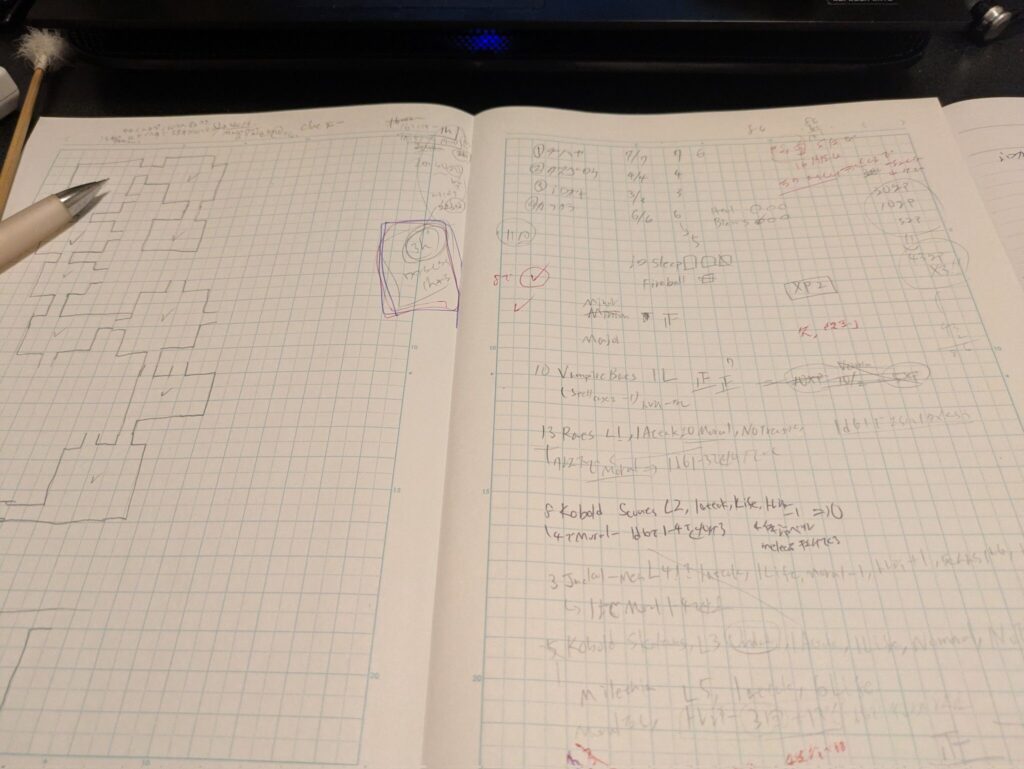
The dungeon itself is also generated automatically with dice.
Reading comments from the Reddit community, I repeatedly encountered descriptions of the process of drawing the dungeon into a notebook as:
- Meditative and calming
- Perfect as part of a bedtime routine
Having played it myself, I would say its tactical depth is somewhat weak.
Actually, it is very weak.
Even so, the core gameplay loop is strangely addictive.
You draw the dungeon, move briskly through its rooms, and resolve battles one after another.
It has the soothing rhythm of a satisfying grind-focused game.
Another major strength is the staggering number of spin-offs and supplements available for the game.
Its expandability and sandbox potential are exceptional.
Looking at the official Ganesha Games store, there are an astonishing 102 related products.
Additional classes, wilderness adventures, automated quest generation, guild building, town building, full campaign scenarios—the game has almost every form of additional content imaginable.
It is a true rabbit hole.
Naturally, the core rules alone can provide several weeks of entertainment.
You can begin with those, then gradually purchase whatever additional material you feel is missing.
Summary
Recommended for players who have been overwhelmed by the amount of data management required by solo TTRPGs, or anyone who wants to make dungeon delving part of their nightly routine.
View Four Against Darkness on Amazon Print edition
View Four Against Darkness – Expanded Edition on DriveThruRPG PDF Edition
Ker Nethalas: Into the Midnight Throne
Would you like to descend into a genuinely hardcore dungeon and fight for your survival?
Ker Nethalas: Into the Midnight Throne stands apart from every game introduced so far.
It is a high-difficulty survival roguelike TTRPG.
You play as a condemned criminal cast into an underground necropolis filled with corruption and chaos.
There, you repeatedly wander along the boundary between life and death while searching for some way to survive.
One of the game’s defining features is the overwhelming number of character-building options.
You may freely combine any two Masteries—the game’s equivalent of classes.
This produces a total of 190 possible combinations.
A fire-wielding assassin.
A scout who fights with their bare hands.
A cleric who creates duplicates of themselves.
You can construct almost any kind of build and throw yourself into the battles awaiting beneath the necropolis in whatever style you prefer.
The enemies in this game are extremely powerful, while resource management is brutally demanding.
Even advancing by a single room can place you face-to-face with death.
Fortunately, the game is exceptionally well designed and provides a wide range of countermeasures.
You can flee from dangerous enemies rather than fighting them.
You can survive desperate situations by using consumable magical items at the right moment.
But as you continue, your torchlight begins to fade.
Your food supplies start running low.
This is a problem.
You need to establish a camp and replenish your consumables.
However, this game uses a system in which every consumable you craft at camp increases the probability of being ambushed when the camp ends.
Even if your torch supply is running dangerously low, should you first eliminate nearby enemies to secure the area?
Or should you craft several consumables at once and gain an advantage through greater action efficiency?
Thanks to its enormous build freedom and extremely high tactical depth, Ker Nethalas is a relative newcomer that has recently begun establishing a powerful presence within the community.
The separate Book of Masteries adds new Masteries—always welcome in a build-focused game—and doubles the number of available skills for the existing Masteries.
I wrote an actual play journal as a log of survivor, please read it if you are interested in what game this is.
Will you step into the necropolis that devours all who enter?
Ker Nethalas: Into the Midnight Throne – Blackoath Entertainment | Ker Nethalas | DriveThruRPG
The Book of Masteries – Blackoath Entertainment | Ker Nethalas | DriveThruRPG
Summary
Recommended for players who want overwhelming character-building freedom and a brutally difficult hardcore dungeon.
View Ker Nethalas: Into the Midnight Throne on Amazon
View The Book of Masteries on Amazon
Mythic Game Master Emulator
Mythic is almost completely unknown in the Japanese-speaking world.
In the English-speaking solo TTRPG community, however, its name appears in practically every discussion of the subject.
That said, Mythic is not itself a TTRPG system.
It is a tool designed to be used alongside existing TTRPG systems, adapting almost any of them for GM-less solo play.
It works particularly well with systems such as Dungeons & Dragons, which offer extensive combat and character-development mechanics.
Fate Questions generate the scenario, while the Threads List maintains thematic consistency throughout the campaign.
The system can automatically generate everything from an NPC’s spoken response and hidden intentions to the concealed truth behind the entire world.
It even provides highly desirable advice for solo players, such as methods for modifying published scenarios so that they can still feel like a first-time experience even when you have already encountered spoilers.
Unfortunately, it has not been translated into Japanese.
Its other weakness is that the content is so extensive that using the system at full capacity can become rather demanding.
However, because it is available as a PDF, you can translate the parts you need and adopt individual tools rather than attempting to use every piece of advice.
This allows you to customize Mythic according to your personal preferences.
Mythic Game Master Emulator – Word Mill Games | Mythic | DriveThruRPG
I wrote about Mythic Game Master Emulator in detail, so please read it if you are interested in it.
Conclusion
What did you think?
Did you find a TTRPG system you would like to try?
To finish, here is the recommendation guide organized by player needs once again.
Quick System Guide by Player Needs
Want to jump in and start playing immediately?
→ Nobi Nobi TRPG Series
Want simple rules and a gentle, heartwarming world?
→ Small Heroes RPG: Utakaze
Want a full-scale, highly varied long-term campaign and plenty of character building?
→ Sword World 2.5
Want to explore challenging random dungeons while building your characters?
→ Arianrhod RPG 2E
Want emotional drama, spectacular dice rolls, and over-the-top chuunibyou-style superpower battles?
→ Double Cross The 3rd Edition
Think the real appeal of solo TTRPGs is creating stories—and would love the rules to be free?
→ Ironsworn
Want to take a four-character party into a dungeon for an hour before bed?
→ Four Against Darkness
Want to build a character and conquer a genuinely hardcore dungeon?
→ Ker Nethalas
Want a tool that can adapt your favorite system and scenarios for solo play?
→ Mythic Game Master Emulator
Enjoy your gaming life!!
Thank you so much for reading to the end!!