When creating, characters sometimes start speaking about things you never even thought of.
It’s that thing where “characters move on their own.”
Some people create precisely because they find that enjoyable.
In our interview series “Visiting Your Origins,” we follow indie game creators’ creative motivations and the small daily trials and errors they go through.
For those who find “the more you hear about people’s creative philosophies, the more interesting they become”
For those who have lost sight of their own motivation
I hope this article reaches you.
This time, we spoke with Kiseki Kobo Games.
Thank you so much!
As a work introduction section, I also wrote a feature article on their game Funeral Flowers Lament Helena, so please check it out.
I’m Kiseki Kobo Games, an individual developer creating games using “SRPG Studio.”
I love thinking up stories and bringing them to life.
I love people who tackle things with passion—they shine so brightly.
Looking forward to working with you.
—Let’s start with a light icebreaker! It’s gotten suddenly hot lately, but how do you deal with the heat, Kiseki Kobo Games?
I deal with it by building a body that’s resistant to heat.
Specifically, through sweat gland training.
Soak in the bath for 3 minutes, then cool down for 1 minute.
By doing this for 5 sets, your sweat glands are trained and your body becomes better at regulating temperature.
—In one sentence, what kind of game is Funeral_Flowers_Lament_Helena, which you’re currently developing?
An SRPG that emphasizes the presence of each individual character
Habits for Creating
—I understand you keep a notebook where you jot down ideas for your creative work. Was this game perhaps born from one of those notebooks?
This game is a bit of an exception. The foundation came from a world I created freely while trying to “get familiar with SRPG Studio.” While working with the tool, I shaped it into a complete work with proper narrative length and structure.
By the way, stories born from my creative notebook will likely be developed using a different tool.
—I heard that you make it a habit to use your left hand to train your right brain for creative work.
Could you tell me about the specifics of that training?
The training consists of the following:
Doing calligraphy with my left hand.
Using my left hand during meals.
Operating the mouse with my left hand as well.
What I find especially effective is writing out creative ideas on paper using my left hand. Watching vague ideas take concrete form and shape into something usable as I write them down is incredibly satisfying.
What Started the Creative Journey
—Could you tell me what inspired you to start creating?
I’ve always loved experiencing and immersing myself in different worlds.
I think my creative journey started with thoughts like “If it were me, I’d want this kind of world” or “How would people react if I presented it this way?”
—I understand that you discovered SRPG Studio through a game called “Goliath’s Adventure” by Takashi Mochinohe. What drew you to that work? Also, were there any aspects of it that you consciously incorporated into your own game?
I was strongly drawn to the “joy of feeling your growth” as you control units with your own hands, level them up, and defeat enemies. It was a meaningful work that reaffirmed “this is the kind of game system I love.”
While “Goliath’s Adventure” contains some content that may not appeal to everyone, I personally rate its portrayal of relationships between characters very highly.
Realizing that I feel a sense of immersion when I understand how characters think has been incredibly significant for my own creative work.
A “Character-Centered” Approach
—In Katsushika Rokusai’s interview, you cited “an SRPG with a small elite force that emphasizes the presence of each individual” as a defining feature of your game.
When you depict each character in detail, it seems to me as a layperson that the direction differs from the large-scale stories typical of SRPGs.
Could you tell me how you thought about leveraging “having fewer characters” in your scenario?
My creative style is consistently “character-centered.” I weave stories by working backward from the endings—thinking about what kind of lives the characters have lived.
When there are many characters, the spotlight on each individual inevitably becomes diluted and weaker. But I want to know—and write down—each person’s “way of life” more deeply.
In my work, I am a reader before I am a creator.
To me, a “way of life” isn’t just about piling on background details. It’s about depicting “how they think at this moment and why they reached that ending” in a way that makes sense from a third-person perspective—as a complete experience. To achieve that, I had to limit the number of characters.
A Reader Before a Creator
—The stance of being “a reader before a creator” is striking. So I’d like to ask: when you create characters, do you work from the premise that you know everything about their lives?
Or do you work from the premise that there may be moments in their lives not depicted in the story—moments even you don’t know about?
I don’t know everything about my characters’ lives.
Rather, the driving force behind my creative work is the curiosity to know my characters deeply.
“Why did you reach this ending?” “Why did you take that action?” “Are you okay with that?” Through dialogue with the characters, the story unfolds. Sometimes answers come easily; sometimes they don’t.
When they don’t, I infer reasons from their journey so far, observing them carefully while searching for answers.
Characters are alive within the story, so even if an action seems contradictory at first glance, there’s always a consistent thread when you consider their underlying philosophy.
The moment I see that consistency is when the character has given me their answer. As the creator, I focus on understanding and depicting their philosophy.
I believe that if I engage in deep dialogue to truly know my characters, their compelling contours will naturally emerge and reach the readers. If they don’t reach the players, that’s my failure in depiction.
Three Unforgettable Games
—Please tell me about three unforgettable games and why they’re unforgettable!
① “Shining Force III”
I was deeply impacted by the three-part structure that depicts the same timeline from different protagonists’ perspectives. As a “method for depicting a work’s world more carefully and deeply,” the choice to change perspective without changing the timeline remains strongly memorable to this day.
② “Dragon Quest VII: Warriors of Eden”
I love how each island features its own rich, self-contained human drama. Experiencing stories in the closed space of an island (a micro perspective) before gradually revealing mysteries on a global scale (a macro perspective)—I find this structure brilliant as a technique for conveying a work’s world deeply.
③ “Fire Emblem: The Sacred Stones”
This work features route branching for each protagonist and training elements through free maps. Switching protagonists and following parts of the story from different perspectives allowed me to immerse myself more deeply in the world. I also remember being pleased by the moderate replay value—being able to train favorite units to my heart’s content rather than just finishing and being done.
What Matters in UI and Systems
—Your custom UI is extremely well-crafted, and you frequently post progress updates on UI improvements on X.
When revising the UI, what criteria do you use to pursue a “better UI”?
Aiming for long play sessions, I use two main criteria: “gameplay tempo” and “being able to grasp desired information instantly.”
Unlike video content, games are primarily about the time players spend actually operating them. The better the UI, the less players notice it. But I think “not being noticed = being naturally accepted,” and that leads to “fatigue-resistant design = long play sessions.”
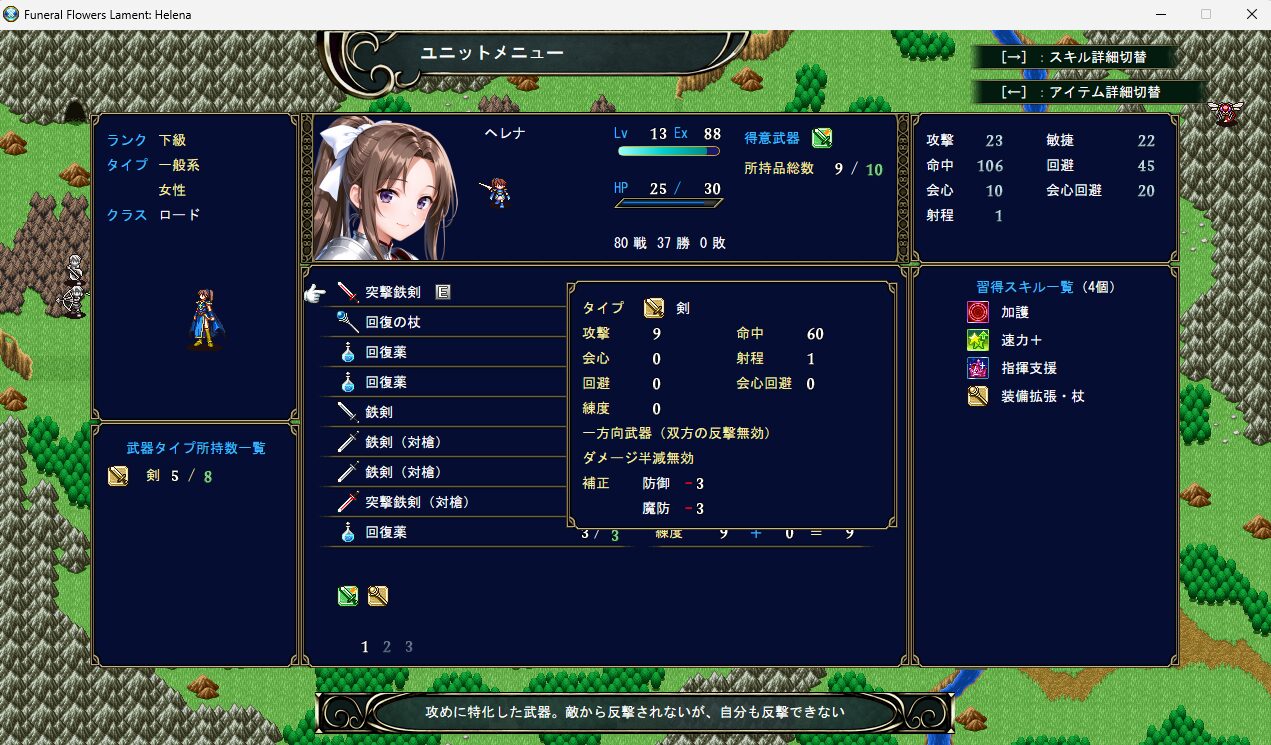
—This game introduces unconventional systems, such as weapons that break the weapon triangle (like swords with lance effectiveness) and most weapons being able to attack from two spaces away.
How did these systems come about?
In games with affinity systems, players genuinely want to “fight with advantageous matchups.” But in many works, weapons that reverse affinities don’t appear until mid-game, or they’re expensive enough to make you hesitate to use them. That’s why in my own work, I wanted to make them available from the start as part of the “basic tactics” players can freely incorporate, so I implemented them that way.
Also, I made standard weapons attack from 2 spaces away purely because I want players to enjoy “the fun of defeating enemies.” I wanted to eliminate the stress of walking around vast maps for multiple turns just to engage enemies, and instead increase opportunities (tempo) to engage and defeat them.
Games I Want to Make in the Future
—Could you tell me about the concept for the story born from your creative notebook that you plan to develop with a different tool?
It’s a story set in a sword-and-sorcery fantasy world, depicting a war between a kingdom and an empire over healing secret arts.
To end the conflict between nations, imperial princesses and their small group of guardians work in secret.
Therefore, rather than focusing on full-scale warfare with massive armies clashing, it centers on the drama of a small elite group of envoys.
I want to create a work where players can enjoy the tense journey and human relationships of these characters.
A message for readers
—Please share a message for our readers!
Thank you so much for reading this far!
This work contains all my passion and philosophy in depicting the personalities of the characters and creating a comfortable experience where players can immerse themselves without stress.
If this has piqued your interest even a little, I’d be delighted if you’d play my work “Funeral Flowers Lament: Helena,” which embodies my design philosophy, and support me by adding it to your Steam wishlist.
Thank you very much!
In closing
So, what did you think?
Did you catch a glimpse of Kiseki Kobo Games’ creative approach?
So, thanks to Kiseki Kobo Games for answering the interview, and to Katsushika Rokusai for the introduction!
We’ve also featured Kiseki Kobo Games’ upcoming title, “Funeral Flowers Lament Helena,” so if you’re interested, please check it out.
And in “Visiting Your Origins,” I’ll continue interviewing indie game creators going forward.
(If you’re an indie game developer and you’re thinking, “I might be interested,” I’d be glad if you reached out via the contact form.)
In the previous “Visiting Your Creative Origins,” we spoke with Med.y.m, who continues to explore 2D expression with dedication. I’d be happy if you’d read that one too.
In “Pre-Release Spotlight,” we create pre-release feature articles and the interview series “A Glimpse of the Roots, Dropping In,” with an emphasis on going beyond “it’s fun” and digging into why it’s fun, based on real hands-on play with demo and early access builds.
By doing so, we aim to create a precedent that says, “It’s okay to talk about this game,” and to sow the seeds of a fan community.