This post is also available in:
This is the fourth installment of ‘Pre-Release Spotlight’!!
In this series, we focus on pre-release titles and quietly delve into the play experience, design intentions, and creative foundations.
For the fourth edition, we’re featuring ‘Funeral Flowers Lament Helena’ by Kiseki Kobo Games.
Grab some snacks and give it a read.
Today’s Guest
Kiseki Kobo Games

This series is done with the simple hope of creating a casual space to talk about games.
Readers who come across this should feel free to talk about games casually too.
So, let’s get into it.
Overview of Funeral Flowers Lament Helena

Genre: SRPG
Developer: Kiseki Kobo Games
The tagline is ‘An SRPG that values the presence of each individual.’
The number of recruitable characters is limited to 13-15, and you can fight alongside all recruited characters until the end.
As touched upon in the interview (link), the creator’s dedication extends to the life each character has lived and the stories not explicitly told.
The UI and tactical design feature numerous unique elements, showcasing thoughtful consideration for players.
This time, I’d like to dig into the unique aspects and points of dedication in the system design and player guidance that particularly drew me in during my playthrough.
<少ない認知負荷で楽しむ>UI and Guidance Optimized for the Experience
Custom UI Continuously Improved Almost Daily
The first thing you notice when playing this game is the custom UI.
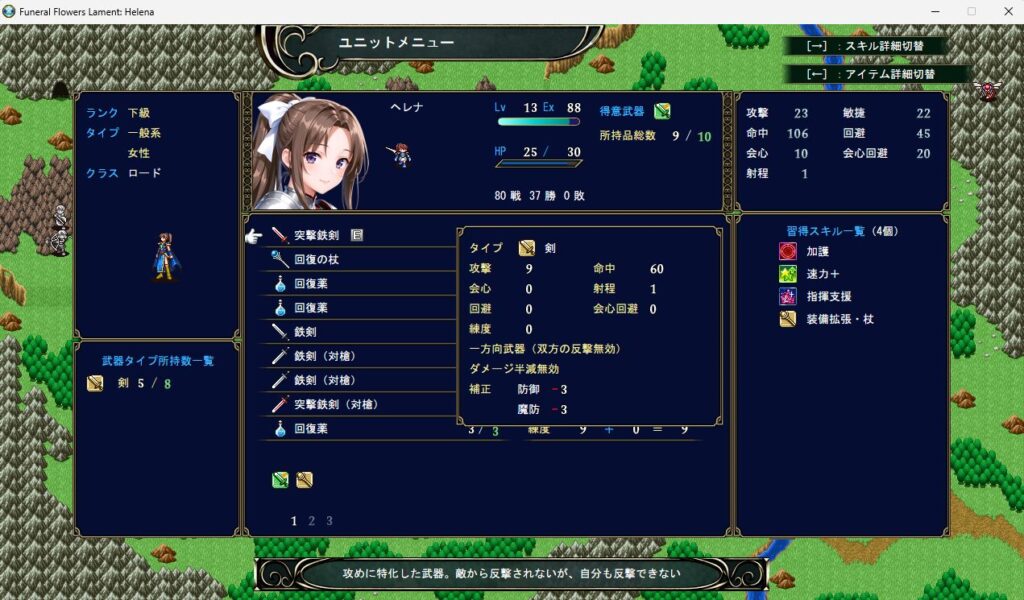
It’s designed to present information compactly within a single screen.
The speed of UI improvements is remarkable, with the creator posting updates on X almost daily showing revisions based on feedback.
Information Presentation that Reduces Cognitive Load
This game consistently maintains a design that reduces cognitive load in both story and system aspects.
First, regarding cognitive load on the story side, when I asked the creator about it,
Many players were quitting within 10 minutes of play, so we cut all the backstory explaining how the world came to be.
Personally, I think it could be trimmed down even more.
was the response.
This revealed an attitude of ‘reducing the burden on players so they can enjoy the game more smoothly.’
Indeed, when playing, the story progresses quite briskly.
While the story lays foreshadowing that hints at larger-scale developments later on, the demo version keeps the story’s scope quite focused—centered on protagonist Helena’s encounters and growth with companions, and skirmishes with monsters in a small region—allowing the narrative to progress at a good pace.
This effort to reduce cognitive load extends to the system design as well.
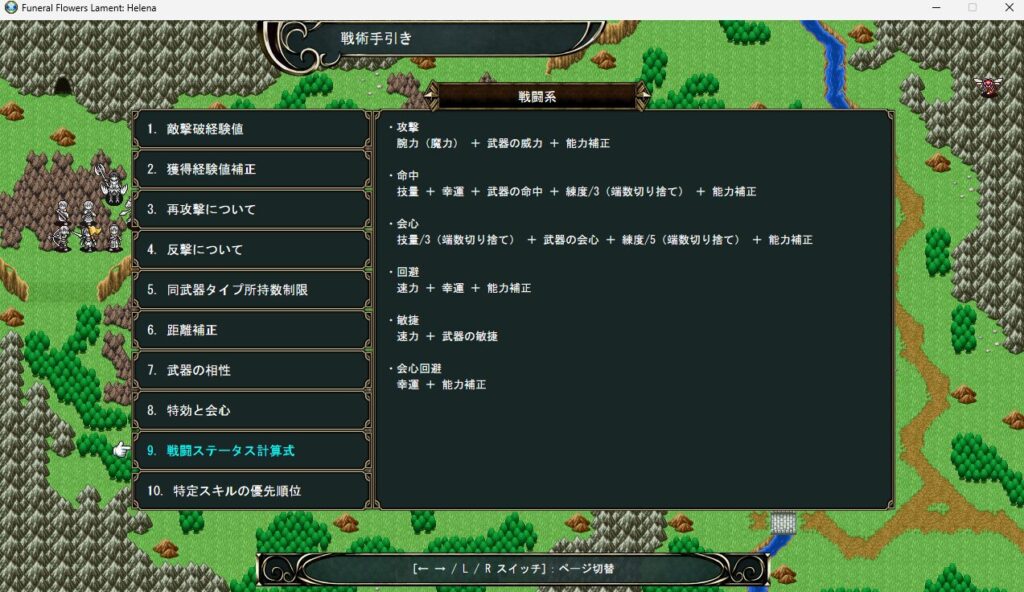
Incredibly, there’s full disclosure of battle calculation formulas—a treat for the 600 SRPG data enthusiasts nationwide!!
Delicious!! I could have three bowls of rice just from this!
Furthermore, from experience point correction formulas to damage reduction rates for ranged attacks, nearly all combat-related data is available for viewing.
Simple Strategic Interplay with Assault and Defensive Weapons
A distinctive system in this game is the assault weapon and defensive weapon mechanics.
Assault weapons have extremely high power and don’t even allow enemy counterattacks, but have limitations in range and critical rate, and apply defensive debuffs when used.
Defensive weapons have low power and accuracy with short range, but have high critical rates and apply defensive buffs when used.
Using regular weapons and these two weapon types appropriately based on the situation is the shortcut to clearing stages.
When I played the demo, I often got overwhelmed using only regular weapons, but once I became conscious of ‘whittling down with assault weapons’ and ‘tanking with defensive weapons,’ things stabilized dramatically.
Combined with the weapon triangle system inherited from Fire Emblem, this creates simple yet enjoyable strategic interplay.
Map Design and Weapon Range that Increase Tempo
All maps in this game are standardized to the same size.
According to the creator, this is a measure to ‘speed up engagement and increase tempo.’
Additionally, weapon range—excluding the assault and defensive weapons mentioned above—basically allows attacks from 2 tiles away.
When actually playing, the comfort of two-tile attacks in particular is significant.
You can defeat enemies smoothly, level up, and grow your characters.
Conversely, this also means you’re more susceptible to enemy counterattacks, but this is where assault weapons come in.
Whittle down with assault weapons, position yourself in defensively advantageous locations, and finish off with two-tile attacks.
The design naturally encourages enjoying this kind of coordination between characters.
For Those Who Want a Finely Tuned Game Experience
‘Funeral Flowers Lament Helena’ is a game with thoughtful consideration for players extending to its custom UI, information disclosure, and story pacing.
If you want to play stress-free while feeling the creator’s care, check it out.
So that’s the introduction to ‘Funeral Flowers Lament Helena’!
I also had the opportunity to interview the creator, Kiseki Kobo Games, so if you’re interested, check that out too.
Wishing you a great gamer life!
Thank you for reading to the end!
→Previous Pre Release Spotlight “Verdant Requiem”
On X, I loudly shout about new article updates, impressions while playing, what it’s like trying to make games, and more.
About 1.3x louder than the blog posts (according to our own metrics).