This post is also available in:
This article contains affiliate advertising.
A game probably never emerges from absolute nothingness.
New games are born from the soil formed by all the games that came before them.
And perhaps the experience of playing those newly born games creates a kind of story in its own right.
But what lies beneath that soil?
For this installment of my interview series, Visiting Your Origins, I spoke with MemoryPixel, a creator with a great deal to say about system-driven narrative.
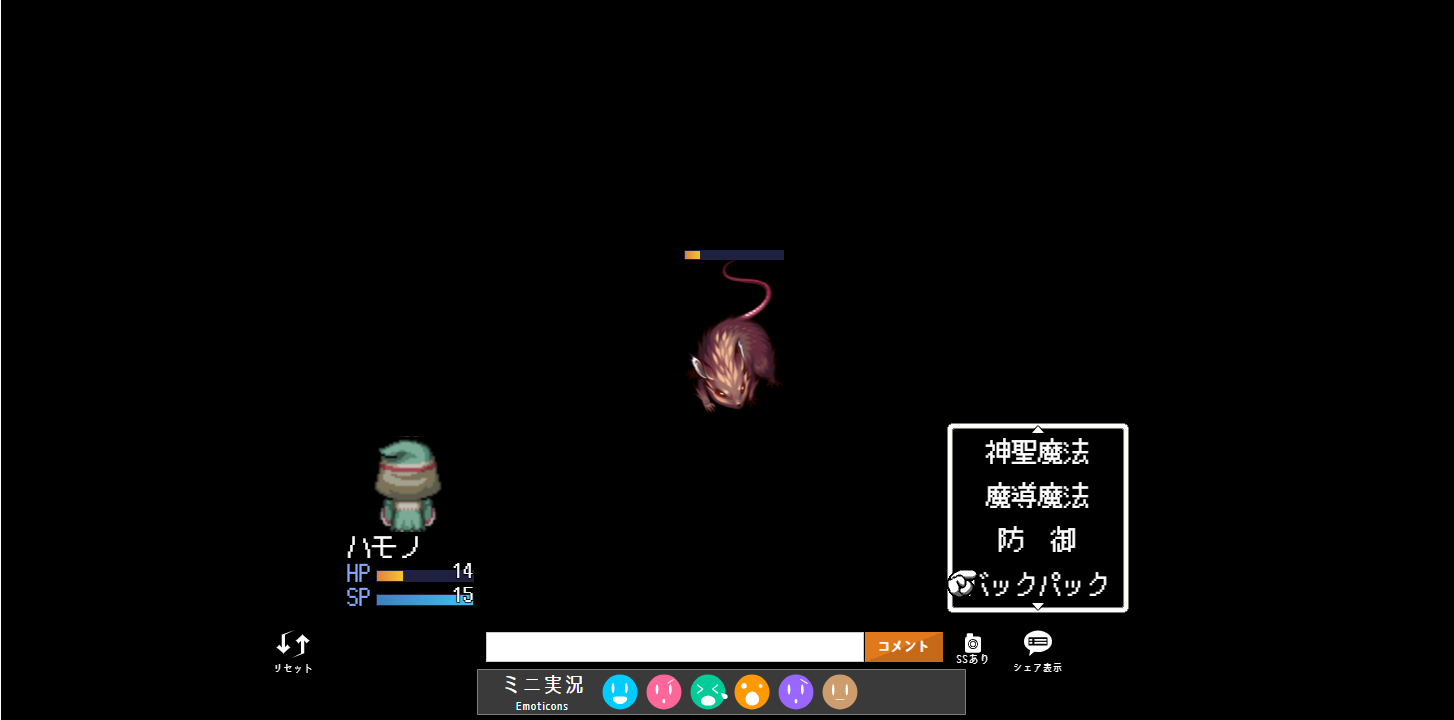
I have also written a separate article introducing MemoryPixel’s hack-and-slash dungeon-crawling RPG, Dungeon Fantasia (Link), so be sure to check that out as well.
All right.
Let’s get going.
- Introducing MemoryPixel
- I Want to Create an Adventurer Simulator in RPG Maker
- What Kinds of Systems Create Freedom?
- What to Inherit from Retro RPGs—and What to Deliberately Change
- What Are the Advantages of the Expressive Techniques Used by 1990s Game Consoles?
- Three Games I Will Never Forget
- The Goal Was to Generate Narrative Through Mechanics
- Narratives Created by Players
- What Changed Significantly from the Initial Plan?
- What Do Players Expect from Hack-and-Slash Games?
- A Drop System Designed to Preserve Player Freedom
- Realizing Hack-and-Slash Gameplay Through a Custom Development Plugin
- Developing Through Rapid Cycles of Scrap and Rebuilding
- A Message for Readers
Introducing MemoryPixel
Our guest this time: MemoryPixel

Official website:
https://ci-en.net/creator/15284
Game currently in development:
Hack-and-slash dungeon-crawling RPG Dungeon Fantasia
Play the alpha version for free in your browser:
Play the Alpha Version of the Hack-and-Slash Dungeon-Crawling RPG Dungeon Fantasia! – Free Games on PLiCy
Previous Creative Work
Hack-and-slash action RPG Rengeki no Kenshi Alpha Version
Released on Game Atsumaru on May 19, 2021.
It was played approximately 50,000 times in total.
It is currently available to play on PLiCy.
▶ Play the Alpha Version of the Hack-and-Slash Action RPG Rengeki no Kenshi
https://plicy.net/GamePlay/153154
—First of all, please introduce yourself!!

My name is MemoryPixel.
Since 2022, I have been active as an indie-game planning and development circle with a particular love for RPG Maker.
With the concept of creating “nostalgic, retro-style RPGs and adventure games,” I have been developing titles such as:
- The hack-and-slash dungeon RPG Dungeon Fantasia
- The hack-and-slash action RPG Rengeki no Kenshi
—Let’s begin with a light question! We’ve been having some very strange weather lately, where it is difficult to tell whether it is hot or cold. Have the sudden temperature changes affected your health?

Thank you for asking. I’m doing fine so far!
—How would you describe your current project, Dungeon Fantasia, in a single sentence?

Dungeon Fantasia is a hack-and-slash dungeon RPG built around the theme of “the life an adventurer leads.”
Its game systems are based on a combination of hack-and-slash gameplay and dungeon exploration, but in terms of the work’s broader themes, I have been creating it while continually asking myself, “What exactly is an adventurer?”

The basic structure is extremely simple: a turn-based battle system combined with dungeon crawling.
At the same time, I have placed great importance on the freedom players have when building characters, assembling parties, and deciding what actions to take, as well as on making the UI easy to understand.

I have also independently developed and implemented a main-scenario selection system that allows each scenario to be completed in around two to three hours, so players can repeatedly enjoy a wide variety of adventures.
I Want to Create an Adventurer Simulator in RPG Maker
—While playing Dungeon Fantasia, I encountered moments when the types of monsters appearing inside a dungeon changed. I wondered whether this represented changes in the dungeon’s ecosystem.
If you had to rank the reasons for adopting this system, how would you order the following three objectives?
- Increasing immersion in the game’s world
- Preventing players from becoming bored by fighting the same enemies repeatedly
- Creating the aforementioned variety by changing drop tables and which skills are effective

Yes. In this game, I independently developed an encounter system in which the enemies appearing in a particular dungeon change each time according to factors such as the current scenario, active requests, and the passage of time in the game world.
One of the fundamental design philosophies behind this game is:
“I want to create an adventurer simulator in RPG Maker.”

Even when considering a single dungeon, it seems natural to me that the monsters inhabiting that dungeon would change as time passes within the game world.
That philosophy has been incorporated directly into the game system.

Therefore, I would rank the objectives as follows:
- Increasing immersion in the world and in the experience of being an adventurer
- Preventing players from becoming bored by repeatedly fighting the same enemies
- Creating greater build variety by changing drop tables and which skills are effective
That is why I believe the game needs a system representing changes in a dungeon’s ecosystem.
What Kinds of Systems Create Freedom?
Freedom of Adventure Through a Divided-Scenario Structure
—Dungeon Fantasia uses a structure in which the story is divided into separate scenarios. How many scenarios are ultimately planned, and what will the total playtime be?

At present, I am planning for the overall story to reach its final ending after six main scenarios.
It will depend on how much the player has developed their characters, but I am expecting each scenario to take around two to three hours.

Therefore, my average estimate for the total playtime is roughly twenty hours.
That being said, it is the player who decides when an adventurer’s journey comes to an end.
It is not necessarily the case that the player must complete Scenario 6 before they can consider their adventure finished.

I think it is perfectly acceptable for somebody to complete only Scenario 1 or Scenario 2 and treat that as their ending.
That is also why the ending credits are displayed after every scenario.
The more main scenarios the player completes, the deeper their understanding of the game’s world becomes.

However, the decision of where to place the ending of their life as an adventurer is fundamentally left to the player.

As an additional note, I independently developed the game’s scenario-selection system, and each scenario is completely self-contained.
This system was influenced by Sorcerian, which was released in 1987.
Because the game’s structure makes it relatively easy to add new scenarios later, I would love to create additional content if the opportunity arises, depending on player reactions and requests and whether I have enough development resources.

That could include side stories or additional scenarios that explore individual characters in greater depth.
The scenario-selection system can accommodate both short stories and longer adventures, so I am personally very fond of it.
Freedom of Character Building Through Equipment
—In Dungeon Fantasia, finding equipment with a high enhancement value or obtaining a unique item can cause an enormous leap in combat power, allowing the player to experience the thrill of overwhelming their enemies.
On the other hand, I felt that increases in combat power from character levels were deliberately restrained, with the exception of HP.
Was this balance chosen so that collecting equipment would become the primary form of character progression?

The purpose is to allow players to create adventurers with truly free character builds.
For example, many RPGs use a class or job system.
In those systems, each class may have different stat-growth rates, and the skills a character can learn are determined by their class.
However, when you think about what an adventurer can be, there are certain kinds of characters that are difficult to represent through a class system

For that reason, every character principally shares the same base statistics.
There are no statistical differences based on appearance, sex, profession, or similar factors.
Instead, players decide which stats to increase by using stat-boosting items.
Skill acquisition is also freely available, apart from the limit on how many skills a character can possess.
Rather than having players experience a world in which the developer has already decided how a particular character or profession must develop, I want players to create their own experience.
I want them to be able to say:
“This adventurer I created has this appearance, this name, these stats, and these skills. This is the kind of adventurer they are.”
As for the enormous leap in power and the feeling of domination that comes from obtaining a unique item, this is a hack-and-slash game.
Therefore the battle system needs to provide players with exhilaration.

I designed the experience so that the balance of power can suddenly reverse before and after obtaining a unique item.
In other words, it represents the changing contrast between:
“The hardships faced by a novice adventurer”
and
“The experience possessed by an adventurer who has managed to survive those hardships.”
The turning point between those two states is obtaining a piece of unique equipment.
And unique equipment is found within the harsh environment of an unexplored dungeon.
That is the intended progression.
What to Inherit from Retro RPGs—and What to Deliberately Change
—I could feel your respect for retro RPGs, particularly in the early-game difficulty and the screen design.
At the same time, the game also demonstrates an interest in newer forms of RPG design, including everyday-life elements such as food management and delivery requests, along with an accessible UI.
In this game, what have you decided to inherit from retro RPGs, and what have you deliberately decided to do differently?
What I have decided to inherit from retro RPGs is their atmosphere, information design, UI, and artwork.
Part of this comes from my personal fondness for pixel-art 2D games reminiscent of Super Famicom titles from the 1990s.
However, from the perspective of a game developer, the expressive techniques used by game consoles of the 1990s also offer a wide variety of advantages.
What I have deliberately decided to change, on the other hand, is the game system.
Many retro RPGs manage their progression through what could be called a story-driven JRPG structure.

However, I do not want to create an RPG in which players simply retrace a story created by the developer.
I am pursuing a game system that allows players to experience a narrative life as an adventurer within RPG Maker and a 2D RPG.
This game does use story elements to manage progression, but the story is positioned purely as a “play guide.”
The requirements for clearing it are extremely loose.

Therefore, players are free to ignore the story and explore completely different dungeons.
In fact, when watching various people test the game, I have seen an enormous range of playstyles.
Some players did not advance the main scenario at all.
Instead, they explored a dungeon completely unrelated to the central storyline, happened to find a unique item there, and became much stronger as a result.
Some players approached the game like a speedrun, heading directly to the objective dungeon and immediately returning afterward in order to clear the scenario as quickly as possible.
Others repeatedly replayed the same scenario several times.
Some players hired adventurers and added them to their party.
Others increased the size of their party only when they could recruit somebody for free.
Some players completed the game entirely solo without forming a party at all.
Every player has a different playstyle when it comes to RPGs.
I hope people will enjoy the life of an adventurer in whatever form best suits them.
I originally introduced everyday-life elements such as food management and delivery requests so players could experience what it means to live as an adventurer.

However, while observing test players, I found that some of them spent all their time completing delivery requests instead of entering dungeons.
It was genuinely enjoyable to witness so many different forms of adventurer life.
What Are the Advantages of the Expressive Techniques Used by 1990s Game Consoles?
—You mentioned that the expressive techniques of 1990s game consoles offer advantages to developers. Could you give us some examples?
A game is composed of multiple layers.
At the very top is the artwork layer, consisting of the graphics and audio assets that players directly see and hear.
In general, producing assets is one of the most development-intensive parts of game creation.
Graphics in particular require a great deal of work.
Even when considering graphics alone, there are several different questions to address.
- Should the game use 2D or 3D visuals?
If you adopt 3D visuals, the camera work, player-control buttons, and difficulty of learning the necessary development techniques all change.- How high does the resolution of the assets need to be?
The higher the resolution, the greater the amount and density of visual information required.- How many colors should be used, and what should the overall visual style and consistency be?
These are important questions when an artist wants to express an original world.
However, if the artwork itself is not the central concept of the game, it is necessary to carefully consider whether the results will justify the development cost.- Should character portraits be displayed?
RPG Maker uses character portraits by default.
However, they occupy a large amount of screen space and strongly define how a character is perceived.
That is fine if the portrait matches the player’s preferences, but otherwise it can have a negative effect.- Are full-body character illustrations necessary?
- If full-body illustrations are introduced, how many poses and facial-expression variations should be prepared?
- These questions do not need to be answered only once. The required assets must be created for every character.

As the number of scenarios grows, the number of characters naturally increases.
The development cost of assets therefore increases exponentially.
My assumption is that commercial-quality games could be developed by small teams within six months to a year during the 1990s partly because asset-production costs were lower than they are today.
When you consider that history, the development process, and the desired quality of the final game product, I believe the requirements of the graphics layer should prioritize two things:
- It should be familiar to a large number of people.
- Its development cost should be low.

Pixel art was the dominant visual style from the mid-1980s to the early 2000s, across systems such as the Famicom, Super Famicom, and Game Boy Advance.
People of my generation, who grew up playing those games, feel a certain nostalgia for them and appreciate the distinctive expressive qualities of pixel art.
These pixel-art techniques also work extremely well with RPG Maker.
- Because it is retro-style, the game can use a top-down 2D perspective.
This makes the controls simple and easy to understand.- Because it is retro-style, it feels familiar, like a Famicom or Super Famicom game that people have seen somewhere before.
- Because it is retro-style, the assets can use a low resolution.
In fact, excessively high-resolution assets would damage the game’s world and atmosphere.- Because it is retro-style, message windows can display three lines rather than four.
This reduces the amount of information entering the player’s vision at one time.
The content can be understood to a certain extent with a quick glance.
Developers also have to carefully consider their dialogue due to the character limits.
Selecting only the most important information increases the density of what remains.- Because it is retro-style, there is no need to create excessive battle effects or elaborate presentations.
From the player’s perspective, this also improves the pacing of battles.- Because it is retro-style, voice acting is unnecessary.
Voice acting can define the characters too rigidly, and interfere with the player’s imagination.- Because it is retro-style, the game does not need to express every piece of information.
It can leave room for players to imagine.

For reasons such as these, I think the style makes it easier to attract the interest of a large number of people.
Because the number of assets is limited, it is also possible to improve their quality and density while reducing development costs.

This game does not use character portraits.
Instead, it relies on walking sprites.
As a result, even when I add new characters, there is no need to create full-body illustrations or different facial expressions.
As long as I have a single walking sprite—which is already essential to the game—I can add another character.
When I come up with a new idea or scenario, I do not want to spend my development time producing assets.
If I am going to spend that time somewhere, I would much rather thoroughly refine the essential parts of the game:
- The concept
- The motifs
- The player experience
- The rules
- The game systems
- The player’s freedom

Many entertaining games were created during the 1980s despite the limited computing resources available at the time.
A game does not automatically become more enjoyable simply because it contains more assets or more information.
I am not developing assets.
I am developing an RPG.
What I want to create is an RPG-system environment that considers the balance among all of the following:
- The entertainment and originality unique to Dungeon Fantasia
- Accessibility and ease of understanding
- The game architecture that remains invisible to the player
- The stability, extensibility, and maintainability of the code
Three Games I Will Never Forget
—Please tell us about three games you will never forget, along with the moments from them that have remained in your memory!!
Lunatic Dawn: Passage of the Book

Lunatic Dawn: Passage of the Book is a game from the 1990s.
The development of this project began because I wanted to experience that kind of game again in the environment of 2026, but in a way that was easier to understand and simpler to play.
I played it at the time, and it was one of the games that taught me how enjoyable it could be to freely adventure as an adventurer.
Even thirty years later, it remains deeply memorable to me.
View what game Lunatic Dawn: Passage of the Book is on Amazon.
Romancing SaGa

Romancing SaGa was a pioneering title that realized a free-scenario system on a consumer console, the Super Famicom.
Because its progression was managed according to the number of battles the player had fought, the enemies could become very strong.
Combined with the free-scenario structure, I think it belongs to the harsher category of RPGs in terms of difficulty.
However, precisely because of that, the ability for players to adventure freely was an enormous part of its appeal.
View what game Romancing SaGa is on Amazon
The Legend of Heroes III: The White Witch

In contrast, The Legend of Heroes III: The White Witch is a story-driven JRPG.
However, I greatly love its world and its themes.
The ending sequence, “Durzel’s Letter,” was particularly moving.
It was the first RPG that ever made me cry, and it has remained in my memory ever since.
View what game The Legend of Heroes III: The White Witch is on Amazon.
The Goal Was to Generate Narrative Through Mechanics
—All three of your “unforgettable games” seem to specialize in allowing players to experience a narrative of adventure.
They also feel somewhat different in genre from a hack-and-slash game. Could you explain why you added hack-and-slash elements to Dungeon Fantasia when those games did not have them?

It was actually the other way around.
When I first decided to create an RPG in RPG Maker, I never considered a game system other than hack-and-slash.
When you examine it as a form of RPG mechanics, hack-and-slash gameplay is extraordinarily powerful.
It may even be too powerful.
That is why I never considered making an RPG that was not based on hack-and-slash mechanics.

However, if you build the game around hack-and-slash gameplay alone, then all that remains are the most basic RPG rules of combat and growth.

Therefore, I decided to use the adventurer—a motif I personally love—and turn the game into a kind of simulated experience of living in a world as an adventurer.
It could give players valuable experiences, valuable time, and a story that they created for themselves.
You place the player within a harsh environment.
Within that environment, the player uses their own ingenuity to accomplish their objective.
At first, the game may be difficult.

But if they continue, there eventually comes a moment when they become stronger—perhaps because of luck—and achieve a small success.
Rather than following a path laid out by somebody else, they observe the situation themselves, make decisions within various restrictions, and test the results.

I believe experiences like that may remain with the player as part of their life experience, rather than simply being remembered as time spent playing a game.
When creating an experience or scenario, you are always required to create an entrance and an exit.
In that sense, the entrance to Dungeon Fantasia is its accessible combination of a retro style and hack-and-slash gameplay.
The exit is the player making their own decisions, achieving a sense of success, and hopefully experiencing at least some of the work’s themes.
That is the kind of game I am trying to create.
Narratives Created by Players
—When you talk about the player-driven narrative you are pursuing, do you mean episodes such as “accidentally getting a companion killed after hiring them with the best of intentions, and then desperately trying to earn enough money to revive them”?
(Link to the introductory article)

Exactly!
What kind of name and appearance did the player give their adventurer?
What did they intend to do?
What happened?
What kinds of events occurred?
What was the final result?
How did they overcome the situation?
I believe the accumulation of all that context becomes the story of that adventurer.

In Lunatic Dawn, which this game uses as a reference point, players created many adventure journals.
They become unique player experiences and personal memories.

The players are creating the stories of their adventurers while they play the game.
I suspect that the culture surrounding tabletop RPGs had a very strong influence.
They would write character backgrounds.
They would describe dialogue, exchanges, and scenes.
That is the creative power of players who generate new content.
“The player does not simply finish by playing the game. They become a creator of new content.”
I feel that this is one of the greatest qualities of the Lunatic Dawn system as a single-player computer RPG.

I also want to create a game in which gameplay itself generates new content.
I am developing Dungeon Fantasia because I want to read the memories and replays of many different adventurers.
Although the range of experiences and the necessary features available for that purpose are still quite limited.
While developing this game, I purchased a large number of tabletop RPG books from the 1990s.

I have never personally played a tabletop RPG.
However, I became deeply interested in how stories—or replays—are generated through sessions conducted by game masters and players within a simple set of rules.
The RPG-system environment I want to create would allow that kind of experience to be enjoyed more easily, alone, in a computer RPG.
In fact, an early development version of Dungeon Fantasia included a play-log feature that recorded what the player did on particular in-game dates.
However, because the alpha version is played in a browser, the feature would have caused the save data to become excessively large.

Regrettably, I ultimately decided not to include it.
At present, I have my hands full implementing the main scenarios.
However, if development resources allow it, I would like to add more features and events that can generate a wider variety of adventurer experiences.
The game is currently in alpha.
Whether I continue expanding Dungeon Fantasia itself or incorporate these ideas into a future game will depend heavily on the feedback I receive from players of the alpha version.
I would greatly appreciate it if players could send me their impressions and feedback through the test-report form.
What Changed Significantly from the Initial Plan?
—You place great importance on testing after creating a vertical slice during development. What elements changed significantly from your original plans as a result of that testing?

I consider releasing an alpha version—a vertical slice—and allowing actual players to experience it to be an extremely important part of the development process.
Since releasing the alpha version on May 19, 2026, I have received a wide variety of feedback from players and have updated the game almost every day.
When something needs to be corrected quickly, I sometimes release two updates in a single day.
Regarding elements that changed significantly from the initial plan, I believe the purpose of an alpha version is to check whether the hypotheses behind the core loop and game loop function correctly.

The alpha demonstrated that there were no major problems with either loop, so there have been no major changes.
In addition, when conducting an open alpha test, the game architecture itself needs to be relatively close to completion.
Even if the game is called an alpha, once players have spent hours or dozens of hours playing it and possess existing save data, it becomes extremely difficult to make major changes to the underlying game systems.
For that reason, I thoroughly designed the lower layers of the game before releasing the alpha version.
After its release, players began testing it, and I have continued adjusting smaller details, correcting bugs, and improving problems that I had not noticed from a developer’s perspective.
What Do Players Expect from Hack-and-Slash Games?
—I had the impression that you designed the game in a highly deliberate manner by working backward from the questions, “What do players expect from hack-and-slash games?” and “What kind of experience should the game provide in response?”
Has this development philosophy remained consistent since the first time you created a game, or did it develop as you gained more experience?

A large part of it comes from the fact that I was personally a player of hack-and-slash games such as Diablo.
It was also heavily shaped by the impressions and feedback I received from players after operating the hack-and-slash action RPG Rengeki no Kenshi, which I released in 2021, for several years.

If you implement a random-drop system like the ones used in hack-and-slash games without properly adjusting it, probability inevitably means that certain players will never obtain the item they want, regardless of how much time they spend.
The people who obtain the item are happy.
However, the larger the player base becomes, the more people you inevitably create who work hard without ever being rewarded.
Based on the adjustments I made in Rengeki no Kenshi, I designed the drop system in this game at the level of its fundamental rules so that these problems would be less likely to occur.
A Drop System Designed to Preserve Player Freedom
—Could you explain what kinds of ideas you incorporated into the drop system, to whatever extent you are able to discuss them?

In a hack-and-slash game, there are broadly two moments when items drop:
- When the player defeats an enemy
- When the player opens a treasure chest inside a dungeon
However, when these are the only two opportunities, balancing the system becomes rather difficult.

For that reason, Dungeon Fantasia guarantees a unique item as a reward for completing a main scenario.
In other words, the following third opportunity has been added:
- When the player completes a main scenario
The first two depend on the player’s real-world luck during ordinary gameplay.
The third reward is random in terms of which unique item the player receives, but a unique item itself is guaranteed.
They have opportunities to obtain unique items while exploring dungeons.

Players can also save immediately before opening a guaranteed unique-item chest.
This makes it easy to perform what Japanese players often call “selection” or “rerolling” by repeatedly saving and loading until they obtain a desired result.
Whether players choose to use save-and-load selection is entirely up to them.
In principle, the game leaves the decision of whether to use saving and loading—and how to use it—to the individual player.
This also means that players can freely adjust the difficulty of the game for themselves.
Players who want tension, the excitement of obtaining unique items, or an unpredictable experience can minimize their use of loading.
Players who prefer to make steady progress, or who do not have much time available for gaming, may choose to use loading more actively.
Whatever their preferred playstyle may be, I believe it is valid as long as it becomes part of that player’s adventurer story.
Realizing Hack-and-Slash Gameplay Through a Custom Development Plugin
—This is a slightly more technical question, but isn’t creating equipment with enhancement values in the RPG Maker database extremely difficult, both in terms of data entry and game balance?
For example, you cannot easily create a universal rule such as “each enhancement level grants +1 attack.” Instead, each item must be registered separately in the database.
Could you explain what measures you have taken to address that problem?

Equipment with enhancement values is an extremely important part of hack-and-slash gameplay.
However, as you said, the development cost of creating that data in RPG Maker is extremely high.
Because this is a hack-and-slash game, it would normally be ideal to use a random-enchantment system.

However, due to the specifications of RPG Maker’s core scripts, implementing random enchantments in RPG Maker becomes an extraordinarily difficult undertaking.
For that reason, this game creates a large number of enhanced items as static data.
During the early stages of development, creating the weapon and armor data became a major problem.
I therefore developed a custom data-generation plugin that allowed me to mass-produce weapon and armor data.

To give a concrete example, I create base items such as a short sword or longsword.
When I execute a plugin command, the system automatically generates ten versions of each base item with different enhancement values.
In other words, if I create around ten base items, the system can automatically create one hundred pieces of weapon and armor data.
After introducing this system, most of the problems related to data creation were resolved.

However, as you pointed out, the balancing inevitably becomes somewhat broad and imprecise.
Therefore, I do not place excessive importance on strictly balancing the enhancement values of normal- and rare-quality items.
The final objective is to obtain the highest-tier unique items.
Players of hack-and-slash games want the experience of becoming increasingly powerful.
Developing Through Rapid Cycles of Scrap and Rebuilding
—Were there any particularly memorable incidents during development?

Development of Dungeon Fantasia began in July 2025, so it has been in production for around one year.
During 2025, I was primarily developing the foundations of the game systems while also creating a version that could be played continuously from the opening to the ending.
However, I eventually discovered that this structure would make the game difficult both to play and to complete as a development project.
I therefore destroyed everything I had created up to that point and redesigned the game again from zero.

That redesigned version became the current game.
I had not realized this until developing this project, but I feel that destroying something is also part of creating it.
Destroying something you have spent a long time building requires a great deal of courage and produces considerable psychological conflict.
However, once you realize that a particular method will not work, completely destroying it and rebuilding it in a new form can lead to a much better result.
I think it would be extremely difficult to carry out that kind of scrap-and-rebuild process within a large development team.
However, the flexibility of indie and small-scale development makes destroying and redesigning things comparatively manageable.
I strongly feel that this ability is one of the strengths of indie development.
There is a stage where you add and test a wide variety of elements.
Then there is a stage where you remove some of the elements that have accumulated.
A game becomes more refined and dense when the development process includes subtraction as well as addition.
A Message for Readers
—Finally, please give a message to our readers!!

This is a hack-and-slash dungeon-crawling RPG created with an emphasis on player freedom.
Its game systems support a wide variety of character builds, party compositions, adventures, and combat styles.
Players can steadily increase their levels and improve their equipment.
They can combine items to overcome challenges.
The decision of how to complete each request is left to the player’s judgment as an adventurer.
In principle, players can save almost anywhere.
Those who want to progress steadily can save frequently.
Those who want a more thrilling and suspenseful experience can choose not to use saving and loading, creating a much more tense style of play.

I would be delighted if each player could enjoy a freely adjustable and easily accessible adventurer experience at the difficulty level that suits them best.
The game is currently available as an alpha version, and I am continuing development every day as I work toward its completion.
Test-play reports submitted during the alpha period are extremely helpful as development references.
I will also include the names of contributors in the ending credits as test players.
I would greatly appreciate any impressions, feedback, or bug reports you can provide.
▶ Dungeon Fantasia Test-Play Report Form
https://forms.gle/sMmQFcVsCjxvuVqQ8
Previous Interview:Visiting Your Origins #5 Interview with Kiseki Kobo Games ~A Reader Before a Creator ~ – Kaburanai Games
Next Interview:Visiting Your Origins #7: An Interview with Mumei & Mumei — Nostalgia Glimpsed Through a Damp Stagnation – Kaburanai Games